The outcomes of the recently concluded West Bengal assembly elections have not only altered the power dynamics within the state but have also reshaped the political landscape of eastern India. This shift could directly influence the Bangladesh border, the Muslim population of West Bengal, bilateral relations, regional security, and the overall balance of power in South Asia. According to the most recent results from the Election Commission of India, the Bharatiya Janata Party secured 207 seats in the 294-member West Bengal Assembly. The Trinamool Congress obtained 80 seats, while both the Congress and the Aam Aadmi Party garnered two seats each, and the CPI(M) along with the All India Secular Front each won one seat.
This outcome marks the end of nearly one and a half decades of governance by the Trinamool Congress, led by Mamata Banerjee, and signifies the first time the Bharatiya Janata Party has established a government in West Bengal. The disturbing images of violence against Muslims in West Bengal following the elections, particularly on social media, in the wake of anti-Muslim comments made by the newly elected BJP Chief Minister Subhendu Adhikari, are truly alarming. Given that Bangladesh is a Muslim-majority nation, it is imperative to examine the implications of the BJP’s victory in the West Bengal elections on the Muslim community there, the future trajectory of West Bengal’s internal politics, the new realities across the border, and the strategies that can be employed to address the forthcoming challenges facing Bangladesh.
Conversely, the BJP has successfully garnered a greater number of Hindu votes than ever before, secured a notable portion of Muslim votes, maintained the support of the Matua and refugee communities through the promise of citizenship, harnessed the discontent of marginalized groups in North Bengal, and attracted the middle class and younger voters by promoting the concept of ‘double engine’ development. Consequently, this election outcome signifies not only a setback for the Trinamool but also indicates a significant ideological shift in the voting attitudes of West Bengal. BJP’s triumph regarding the citizenship issue: The Special Intensive Revision of the voter list during the recent elections was a strategic move by the BJP aimed at undermining the Trinamool Congress. This revision led to the elimination of approximately 9.2 million names from the voter list, fueled claims of ‘outsiders’ and ‘fake voters’, and instilled a fear of facing citizenship inquiries for those who chose not to vote, which has profoundly influenced the electoral behavior of voters this time.
The Center’s economic non-cooperation with the Trinamool government : The BJP government has been accused of stalling or slowing down mega projects in West Bengal for quite some time. The economic structure of the local government has largely collapsed due to the non-cooperation of the Centre. The BJP has very skillfully exploited the anger at the panchayat level over the economic stagnation, rising unemployment and the deteriorating law and order situation, which is being colluded with by local leaders, to undermine the vote bank of the BJP and the Trinamool Congress. The BJP has not limited this long-simmering anger against the Trinamool Congress to anti-government votes but has successfully combined it with the rhetoric of security for Hindus, central development partnership, increase in women’s allowance, administrative cleanliness and ‘anti-infiltration’. As a result, the regional nationalism of the Trinamool Congress has fallen flat in the face of the central security-nationalism of the BJP.
Overreliance on Young Turks and undervaluation of older leaders :While dissecting the shameful defeat of the Trinamool Congress, most analysts are bringing forward the young-old conflict. According to them, the over-reliance on the Young Turks led by Mamata Banerjee’s nephew Abhishek Banerjee gradually made the senior section of the party inactive from the center to the districts. Although the senior leaders held big positions in name only, the party was controlled from Abhishek’s ‘Camac office’. The main driving force of the party, which was run completely in a corporate manner, was AIPAC, an organization that once worked for Modi. It would not be an exaggeration to say that the Trinamool Congress had to pay the price for Abhishek’s excessive vigilance in the elections and the misbehavior of a group of Young Turks led by him. It can be said that this Young Turk group, working behind the scenes to create distance between Mamata Banerjee and senior leaders, has most likely permanently hammered the final nail in the coffin of grassroots politics.
New challenges created for Bangladesh along the West Bengal border : The rise of the BJP in West Bengal politics could shift grassroots politics—that is, away from the Bengali language, Left heritage, secularism, regionalism, and marginal welfare—to the BJP’s Hindu nationalism, border security, citizenship verification, and Muslim skepticism.
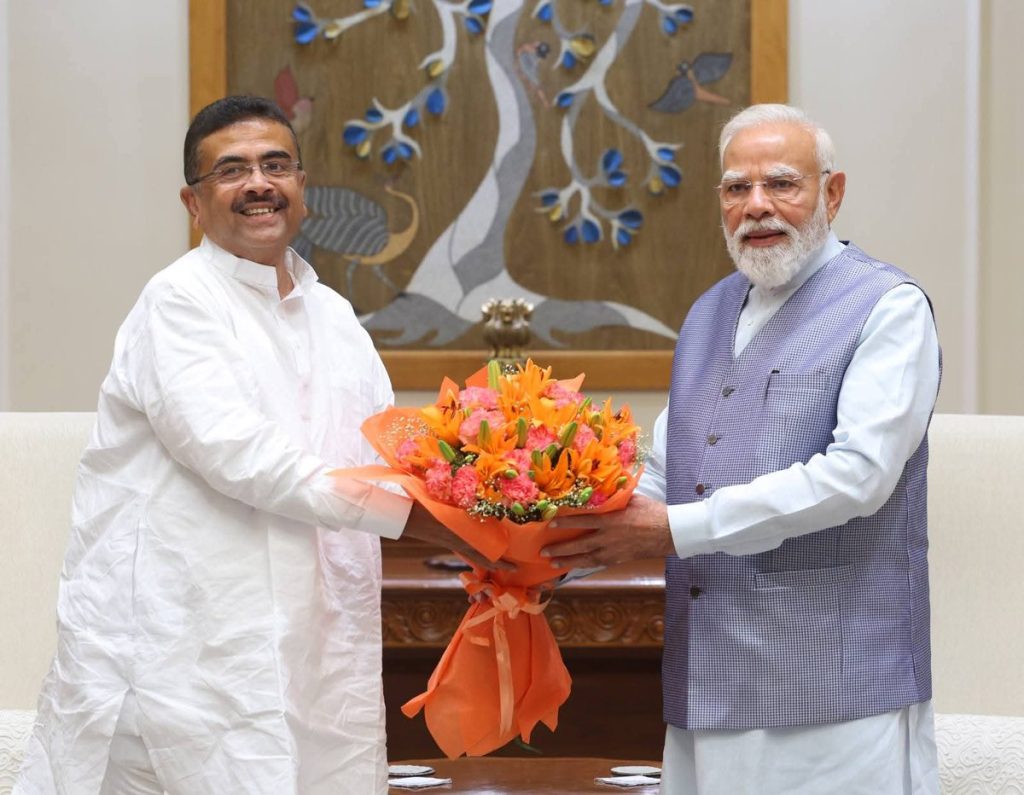
The BJP is likely to consider West Bengal as a geo-strategic location rather than just another state. The state is very sensitive for Bangladesh, as West Bengal shares a 2,216.7 km land border with Bangladesh, of which 1,647.69 km is already fenced and the construction of the remaining border infrastructure has been in the process for a long time.On the other hand, the newly appointed Chief Minister of West Bengal, Subhendu Adhikari, has repeatedly reiterated his tough stance on the border and Muslims. That is, the reshuffle of the West Bengal government could directly create a new reality on the issues of border management, movement of border residents, anti-smuggling operations, riverine surveillance, barbed wire, push-in of Muslims and border killings, some evidence of which is already visible.
New uncertainties have arisen for the Muslim community : This change has created a major concern for the Muslim community in West Bengal. The state has a Muslim population of 28 to 30 percent and they live mainly in the vast areas of Murshidabad, Malda, North Dinajpur, South 24 Parganas and North 24 Parganas. The words ‘Bangladeshi’, ‘infiltrator’, ‘Rohingya’, ‘fake voters’ and ‘citizenship verification’, which are widely used by the Bharatiya Janata Party, are not just limited to election slogans but are at great risk of becoming the language of administrative policy in the future. If such a situation arises in reality, the future of the Muslim community in this state will face difficult challenges.
The reality of a BJP-ruled state: A bad sign for West Bengal : The experience of other Indian states can be considered a warning sign for West Bengal. Human Rights Watch published a detailed report in 2019 on attacks on Muslims and other minorities in the name of protecting cows and urged the Indian authorities to prevent violence and prosecute those who take the law into their own hands. But the central government has not given due importance to this issue. If radical Hindutva organizations such as the Rashtriya Swayamsevak Sangh, Vishwa Hindu Parishad, Bajrang Dal and the so-called Gau Raksha Network receive administrative patronage or political confidence, riots, riots and bloodshed over trivial issues such as cow transport, meat sale, and use of microphones in mosques and madrasas may become inevitable in Muslim-dominated areas of West Bengal. The orders issued by the new West Bengal government regarding animal slaughter will seriously disrupt the Muslims’ sacrifice during the upcoming Eid al-Adha.
Possible future diplomacy and foreign policy of Delhi and West Bengal in the same straight line : The biggest question from Bangladesh’s perspective is whether this political change will change diplomatic relations. Formally, India-Bangladesh relations are in the hands of the Centre, with no state government directly determining foreign policy. This view is also reflected in the statements of Bangladesh’s foreign policy advisors and former diplomats. They do not see any immediate major crisis. According to them, Bangladesh’s bilateral relations are mainly with the central government. But many analysts are strongly against such simplification.
Because even though the state government does not directly formulate foreign policy, the state government has real influence in border management, local police cooperation, political asylum, pressure on border residents, water sharing politics, health tourism, visa issuance and shaping public opinion. That is why the Modi government has strategically evaded responsibility by placing the entire responsibility for the failure to conclude the Teesta water sharing agreement on Mamata Banerjee in the past.
Now that excuse will be weak. As a result, the door may theoretically open for a water deal, but the reality is more complicated. If the same political force turns water, borders, infiltration, security, and Bangladesh’s internal politics into a bargaining package, Bangladesh could face several pressures, as outlined below.
Push-in crisis a big risk for Bangladesh : Push-ins are a sensitive issue for Bangladesh. If the ‘Bangladeshi infiltrator’ narrative becomes an administrative policy in West Bengal, the incidents of pushing suspected people to the border could increase. This will not only create a humanitarian crisis, but it will also become a question of state sovereignty.If Bangladesh accepts anyone without any citizenship verification, it will set a dangerous precedent in the future. Again, it will not be possible to deny the humanitarian crisis of the people stuck at the border. Therefore, Bangladesh will have to make humanitarian, legal, diplomatic and security preparations at the same time. It is worth mentioning here that a few days ago, Assam Chief Minister Himanta Biswa Sarma, in a television interview, shared a heart-wrenching experience of pushing back 1500 so-called Bangladeshis in the dark of night. In completely cold language, he expressed his determination to push back at least 11 lakh more so-called Bangladeshi Muslims. Before the elections, the Chief Minister of West Bengal had ordered 80 lakh to 10 crore Muslims to go to Bangladesh, calling them infiltrators. If elected, he announced that he would send them to Bangladesh. If the BJP agrees with this arrogant statement of his and the pushback plans of the central and state governments complement each other, there is every possibility of the border situation becoming turbulent in the future.
West Bengal may be the base for the return of the fascist Awami League : This political change may also have an unsettling impact on the internal politics of Bangladesh. West Bengal has long served as a safe haven for exiled Awami League political leaders, businessmen, cultural workers, media and influential figures. But now the situation is much more serious than before. Earlier, the main political support of the fascist Awami League was Delhi. Their diplomatic shelter, political lobbying, international propaganda and anti-Bangladesh influence activities were centered in Delhi. With the victory of the BJP in West Bengal, the possibility of the anti-Bangladesh Awami League campaign being conducted from West Bengal, which borders the country, has arisen.
In other words, the BJP government in West Bengal is not just a neighboring state government, it could become a potential launching pad for the return of the fascist Awami League. For Bangladesh, the issue is not just about border security, it will become a question of the state’s political sovereignty, internal stability and future balance of power.
Rumors and security risks : Social media, which has contributed greatly to the rise of the BJP, can create diplomatic tensions between the two neighboring countries by creating rumors. If any mosque, madrasa, religious procession, violence against women or any communal incident centered on beef in West Bengal goes viral on social media, the possibility of creating communal tension in Bangladesh cannot be ruled out. If the fascist pro-Awami League media and pro-India propaganda platforms are added to this, it will be even easier to mislead domestic and international public opinion. In that case, the name of Bangladesh will once again be labeled as an anti-minority and militant state like in the past.
The question is, what can Bangladesh do in such a situation? The answer is, in such a complex situation, we need to take swift, coordinated, and national-level action on some of the following issues.
Raising awareness among border residents : Farmers, fishermen, small traders, cattle breeders, riverine people, and the economy of border markets in border regions like Satkhira, Jessore, Chuadanga, Meherpur, Kushtia, Rajshahi, Chapainawabganj, Dinajpur, Lalmonirhat, Kurigram, and Panchagarh are closely linked to Indian border policy.
If border surveillance increases, border guards become stricter, nighttime movement is disrupted, river searches increase, and the number of shootings or arrests on suspicion of infiltration increases, the border economy will shrink. If border residents suffer from insecurity, they will reduce land cultivation, be afraid to go down to the river, will not take products to the market, and gradually the people of the border region will become economically weak. This will create a tendency among the border people to live in alternative ways, worsening the border security situation.
But these border residents are the first line of social defense, the forward observers of the territory of Bangladesh. However, it is very important to maintain the necessary balance in analyzing the overall situation. It would not be right to come to a simple equation that BJP’s victory in West Bengal means that a flood of refugees or communal tension will start from tomorrow. There is a difference between election language and governance. But at the same time, it is also true that when a radical nationalist force comes to power, field-level organizations become confident, the language of administration changes, surveillance on minority communities increases, and the border starts to be seen as a security front from the point of view of human relations. Therefore, it is necessary to maintain an ever-vigilant stance and closely monitor what policies the West Bengal government adopts in reality.
Formation of the National Security Council : The deeper the internal party divisions in Bangladesh on security issues, the easier it will be for Delhi to exert pressure on Dhaka. In this reality, Bangladesh should form a special National Security Council or high-level Strategic Coordination Council comprising the Prime Minister, the chiefs of the three services, the BGB chief, top intelligence agencies, foreign and domestic policymakers, and some responsible citizens of the country.
The task of this council will not only be to monitor border incidents, but also to jointly monitor and deal with political changes in West Bengal, possible reorganization of the fascist Awami League, propaganda by local and foreign media close to Awami, push-in risks at the border, water and trade pressure, visa politics, information warfare, international use of minority issues, and attempts to spread foreign influence inside Bangladesh. There needs to be a minimum consensus among the government, opposition parties, military-civilian policymakers, border district administrations, and diplomatic circles on these issues. Care must be taken that political parties do not threaten national independence and sovereignty due to conflicts of petty political interests.It is necessary to draw clear lines in diplomacy.
A strong diplomatic stance is needed to defuse any tension at the border. If there are attempts to identify Bangladeshi citizens who accidentally cross the border as ‘infiltrators’, such as push-ins, border killings, forced displacement, harassment on the river in the name of citizenship verification, or mistakenly crossing the border, Bangladesh will have to make its position clear at both the Delhi and Kolkata levels.At the same time, realistic negotiations should be continued on the issues of water, trade, visa, border management and political asylum. India’s internal political changes are their own matter, there is no occasion for us to be overly concerned or happy about this, so there is no room for muddying the waters. We only have to take a clear stand against all kinds of foreign interference in the internal politics of Bangladesh, attempts to rehabilitate the fascist Awami League, any anti-Bangladesh political operations using foreign territory and information warfare.
Border intelligence capacity must be strengthened : For proper border management, every risky sector of the West Bengal border, chars, river routes, informal crossings, border markets, drug routes, human trafficking routes, political asylum routes, networks used by fugitives, hundi channels – in other words, everything needs to be mapped up-to-date. At the same time, if there is no round-the-clock coordination between the BGB, police, district administration, intelligence agencies and local public representatives, there will be a delay in responding to border incidents. There is no room for showing weakness at the border, because showing weakness only increases the number of body bags.
Prevention plan needed before push-in : Another urgent task at the government level is to plan for preventing refugees and push-ins. There may not be a large-scale influx of refugees from West Bengal; but small push-ins at the border, undocumented people, detained families, children, women or laborers could create a humanitarian crisis.
This requires comprehensive preparations for identification, preparation of temporary waiting areas, diplomatic protests, informing the international community, media management, and documentation in human rights documents.We must prepare to combat information warfare.
We need to be adequately prepared to deal with information warfare. If the Indian media portrays Bangladesh as an ‘infiltrator state’, a ‘militant’ or an ‘anti-Hindu state’, then protest alone will not be enough. Bangladesh needs the ability to create an information-based counter-narrative. Just as India has mastered the art of suppressing real news and spreading convenient information, we too need to respond appropriately by creating English-Bangla-Hindi content, increasing our engagement with international research institutions, publishing border data, documenting human rights violations and adopting a consistent stance in diplomatic language.
Strategic relations with China must be strengthened.Another important thing for Bangladesh to do is to make its relations with China more realistic and stronger. To counter Indian pressure, Bangladesh needs a strategic balance so that no single power can unilaterally pressure Dhaka. Deepening relations with China in the areas of infrastructure, defense capabilities, trade, technology, river management, energy, ports, industrial zones and regional connectivity is important for Bangladesh. However, this relationship must be based on Bangladesh’s national interests, not blind dependence.
Proximity to China will create a strategic balance against India. If the Indian central government uses West Bengal as a front to exert political or diplomatic pressure on Bangladesh, it is essential to have real relations with alternative forces in Bangladesh.
Relations with the Muslim world must be reshaped :Bangladesh needs to deepen its ties with the Muslim world. Strengthening political, economic, labor market, defense, education, technology and diplomatic relations with Saudi Arabia, Turkey, Pakistan, Qatar, the United Arab Emirates, Malaysia, Indonesia and other Muslim-majority countries is the need of the hour.When there is anti-Muslim rhetoric in West Bengal or pushback from any Muslim across the border for being a Bangladeshi Muslim, Bangladesh will have to explain its position at the international level. Relations with the Muslim world are not just a question of religious sentiment, but are inextricably linked to questions of labor markets, investment, energy security, diplomatic support, and political balance in international forums.
New strategy needed with ASEAN and Southeast Asia : Another major strategy for Bangladesh should be to expand ties with Southeast Asia. Trade, investment, technology, maritime security, energy, food security and diplomatic cooperation with the strong economies of the ASEAN region, Indonesia, Malaysia, Singapore, Thailand, Vietnam, the Philippines and other countries should be increased. If Bangladesh is stuck in a regional reality that is only India-centric, then Dhaka’s strategic options will be reduced when pressured by Delhi or Kolkata.
Balanced relations with the US and the West are needed : Another pillar of Bangladesh’s strategic balance is its relationship with the United States and the Western world. Bangladesh must maintain relations with Washington, the European Union, the United Kingdom, Canada and other Western powers in such a way that India cannot create unilateral international pressure against Bangladesh in any way. However, this relationship must also be balanced. On the one hand, Bangladesh must work with the Western world in the areas of democracy, human rights, labor rights, security cooperation and trade. On the other hand, it must also retain its sovereign decision-making power.
In particular, we need to openly discuss with the United States that bypassing China, which is known as the heart of the global production system, would be extremely disastrous for our economy, which is impossible for us to maintain. This balance of multidimensional relations will be considered our defense against any unilateral pressure.
Perspective West Bengal: Even within the risks lies immense potential : BJP-led West Bengal is now not just a neighboring state for Bangladesh, it is also a security front. The BJP’s coming to power there is creating both risks and opportunities for Bangladesh.
With the BJP government coming to power, on the one hand, new opportunities for discussions on border management have been created, and on the other hand, new areas for pragmatic negotiations on water and trade issues have been discovered. Therefore, the possibility of bilateral talks with the current centrally-backed BJP government being much more fruitful than with the weak Trinamool government cannot be completely ruled out.
How this transformation in West Bengal will ultimately unfold will depend on the diplomacy of the new state government, the directives from Delhi, the behavior of the border administration, the pressure on the Muslim community, the political support of the BJP to the fascist Awami League, and the reaction of Bangladesh. It is undeniable that the political climate on the western border of Bangladesh has changed. Policymakers in Dhaka must now understand that West Bengal is no longer just a place of culture, medicine, visas, markets and kinship for Kolkata, but could take the form of the eastern front of India’s increasingly aggressive state policy.
This front will not only serve as a means of barbed wire or push-in on the border, it can also become an operational base to bring the fascist Awami League back into Bangladesh’s internal politics. Therefore, Bangladesh must now make overall preparations for the future. This preparation must be made with a cool head, keeping its spine straight, by forming a National Security Council, combining the young and the old, strengthening border intelligence capabilities, developing balanced relations with China-Muslim world-ASEAN-America-West, and keeping national interests above party calculations. All our circles must realize the ongoing global harsh diplomatic reality that the center of gravity of power has now changed a lot. The role of China-Pakistan-Turkey-Egypt and most recently Saudi Arabia in the three-way war of Iran-Israel-United States has changed the future geopolitical context a lot. The wisest course of action, in all respects, would be to overcome the prevailing unilateral dependence rather than ignore this emerging new axis of power. The sooner this understanding is conveyed among us, the faster our desired progress will be accelerated.