




The true face of India has been revealed once again through the recent statements of the new High Commissioner of India, Mr. Dinesh Trivedi, while interacting with the media in Benapole a few days ago. Immediately after reaching the Benapole-Petrapole border, Trivedi told reporters, “India’s population is 140 crore, if another 20 crore is added to it, it becomes 160 crore. I do not want to work separately, but collectively. The sky is one, the air is also one.” He also said that we can be a superpower.
The High Commissioner’s remarks have given rise to various reactions inside and outside the country. Jamaat-e-Islami Ameer Dr. Shafiqur Rahman has urged the current government to seek a formal explanation from the envoy to clarify the exact motive behind the remark regarding “India and Bangladesh are one”.
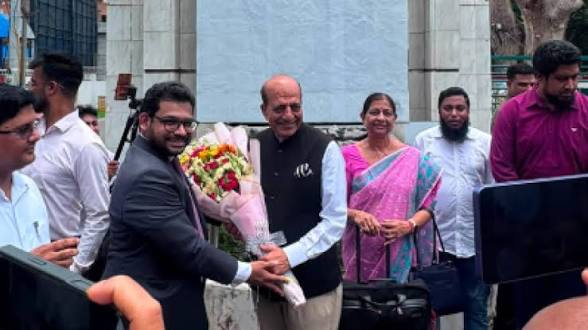
Going beyond the traditional service officers of India (diplomats), Mr. Trivedi is the first Indian politician to serve in this role. It is certain that he has come with a specific assignment or goal from the Indian government. His statement seems to be more political than diplomatic and has already created a stir in the society. It is an established fact that the “Nehru Doctrine” is the ultimate dream of Indian diplomacy. Nehru laid its foundation stone and Indira Gandhi took it forward with the goal of a united India.
The BJP government under Modi has abandoned the traditional secular approach to politics and has embarked on a mission to create a Hindutva state, ignoring the rights of India’s minorities. The mural in front of the Indian Parliament, the multi-faceted military power and the hegemonic control established in the small countries of the South Asian region are a clear signal of building a “united India” in the future. Mr. Trivedi has come with a political objective and will soon emerge as an active player in this mission. As a diplomat, he cannot make such political statements, which are seen as direct interference in the internal affairs of Bangladesh. His statement is a clear proof of India’s ‘Dadagiri’ or big-nephew attitude, which it has been showing since the fall of Nawab Siraj-ud-Daula in the Battle of Plassey in 1757.
Hindu landlords and leaders sided with the British and took advantage of the weakness of the Muslim population to dominate them throughout the British rule. The British also gave them their advantage through their famous ‘divide and rule’ policy. Thus, the Muslims of India became the victims of both the Hindu elite class and the British rulers. Fortunately, some Muslim thinkers and leaders understood this political situation and came forward to protect their community from the Hindu community in the future. Frustrated by the big-nephew behavior of the Congress, the Muslim leaders decided to fight for a separate homeland. And they succeeded in the birth of Pakistan in 1947 under the able leadership of Mohammad Ali Jinnah.
But the Congress leadership did not accept it and formulated the famous ‘Nehru Doctrine’ and started working to implement it. They did not hesitate to occupy Hyderabad, Jammu and Kashmir and Sikkim, but still their dream has not been fulfilled. The creation of Bangladesh is part of their grand plan, which they made right after the birth of Pakistan. Just as India cannot integrate Bangladesh, it cannot accept the independence of Bangladesh either. But they have not deviated from the idea of the Nehru Doctrine even today, at a time when the people of Bangladesh are against any hegemonic influence of India. The recent changes brought about by the July 2024 revolution will never tolerate it in the future. Whenever a weak government comes to power in the state of Bangladesh, India always looks for that opportunity and tries to control it by exerting hegemonic influence.
India established its complete control over Bangladesh during the period of Sheikh Mujib right after its independence. However, they are also calm when they see a strong and popular government in power. During the time of Ziaur Rahman, they lost their control over Bangladesh. But with no alternative to changing the popularly elected government of Ziaur Rahman, they resorted to conspiracy and assassinated him with the help of their local military agents in May 1981. India witnessed the rise and fall of its influence in Bangladesh between the fall of Ziaur Rahman and 2008. They were content with the Ershad government, but fed up with the government of Begum Khaleda Zia, they resorted to conspiracy and succeeded in installing a pro-India Moinuddin-Fakhruddin government in early 2007.
With the help of the US, India brought one of its tested and most reliable friends, Sheikh Hasina, to power in December 2008 and took political control of Bangladesh. Their first political move was to carry out the historic BDR massacre (Pilkhana Tragedy) in February 2009. According to a report by an inquiry commission, this was definitely the result of traditional Indian conspiracy. And they succeeded in breaking the moral backbone of the nation, especially the army.
India provided moral support to Hasina and established its hegemonic control over her government until Hasina lost power in the July 2024 revolution and was forced to flee the country and seek refuge in India. Not only did Hasina lose power, but India also lost control over Bangladesh.
Now, Bangladesh is slowly facing some big challenges with regard to minorities and other issues. It’s imperative that India act diplomatically and must not be subservient to expansionist extremists.

