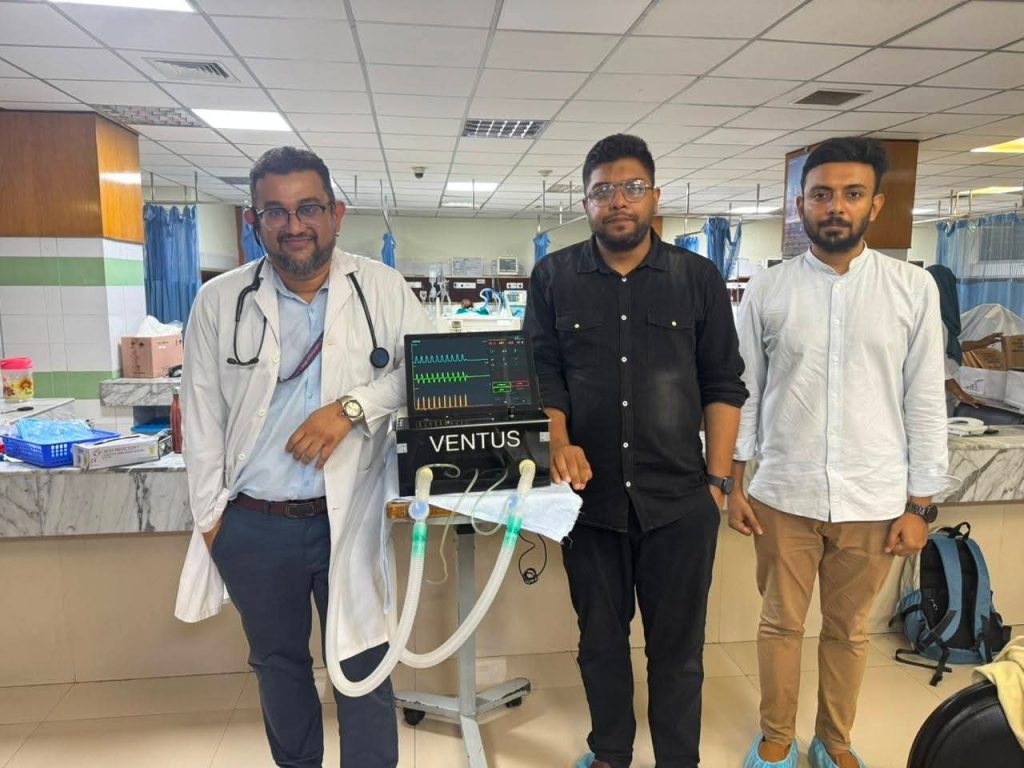
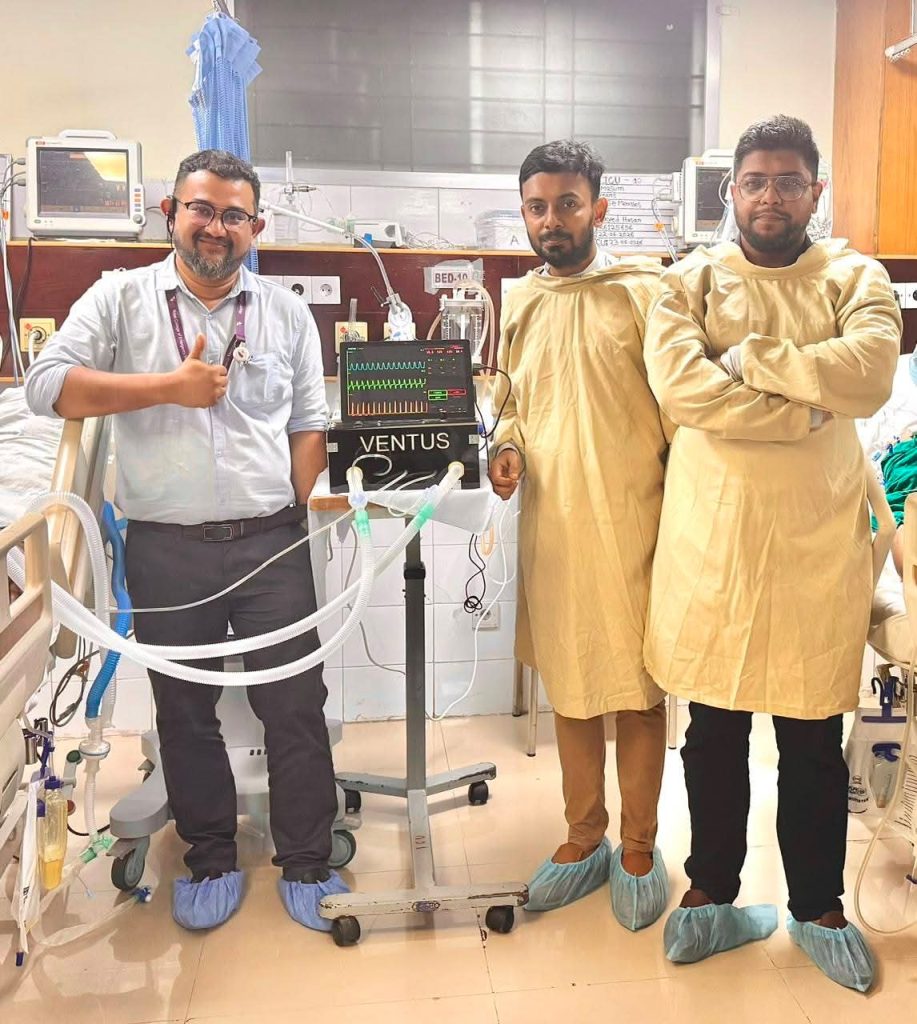
For the first time in Bangladesh at NINS, the initial clinical trial of ‘Ventus’ has been experimented on July 13. The effectiveness of the device was tested on a post-cardiac arrest (Coma Scale 3) patient with all necessary ethical and institutional approvals. At the end of the trial, a 13-member expert medical board reviewed the results and declared it successful. The board reviewed the patient a total of 2 times. This time, the researchers are thinking of further improving the quality of the device and final approval.
The coronavirus struck the country in early March 2020. As the infection increased, the dilapidated skeleton of the health sector became looser. During those days of lockdown, a phrase emerged on social media causing intense panic – ‘ventilator crisis’. Desperate to defend itself, the developed world had stopped exporting ventilators by then. Meanwhile, the country’s hospitals were short of these artificial respirators. As a result, what was bound to happen was this. Hundreds of lives were lost due to the lack of even a little air.The country has come out of the Covid crisis. But the shortage of ventilators in hospitals is still ongoing. This vital life-saving device is still out of reach for most institutions.
These Three researchers from the country have been working silently for seven years with the dream of changing this cruel reality to some extent. They have taken forward their research with their own funding, not any government grant. After overcoming various adversities, the long-awaited success has finally come. The mechanical ventilator ‘Ventus’, made entirely with domestic technology, has successfully passed the initial clinical trial. The researchers believe that this ventilator they have created is capable of starting an unimaginable revolution in the country’s medical sector.
They claim that if ‘Ventus’ is approved, not only institutionally but also as a ventilator, it could become a personal device.
Dr. Kazi Sifayet Enam, a doctor at the Cardiology Department of Dhaka Medical College Hospital, has spent most of his career in the ICU. During this long time, he has seen a cruel reality up close. Numerous patients cannot stay in the ICU for the required time simply because of lack of money. Because the cost of the life-saving medical equipment used there is skyrocketing, the cost of using them is also beyond the reach of the common man.
That experience made him think, if only these devices could be manufactured domestically at a lower cost! And the severe shortage of ventilators during the Corona pandemic made his idea even more urgent.
“I used to work with ventilator machines in the ICU. At that time, I was wondering if this complex machine could be replicated in a simpler version. Then Covid surfaced, creating a panic around the world. At that time, even “developed” countries in the world had banned ventilator exports. The situation in the country was bad. Then I sat down with Engineer Baizid Muktadir Shuvo ,” this is how they narrated their journey.
Meanwhile, Dr. Asif Ur Rahman, ICU consultant at the National Institute of Neurosciences and Hospital, joined this initiative. The path to importing parts from abroad was almost closed at that time. So, Engineer Shuvo started the work of making ventilators using locally available equipment. After a few months of effort, their first prototype, which was named ‘Spandan’, was made. The trial of the device at Dhaka Medical College Hospital had instilled hope among doctors and specialists at that time.
But that promising start did not materialize. While the country has clear policies for drug production, there is no effective framework for research, production, and approval of medical devices. Added to this was the business opposition from some corporate entities. All in all, the ‘Spandan’ project did not move forward.
However, they didn’t stop there. The project gave them the belief that it was possible to make effective ventilators using domestic technology. So, even though it was behind the scenes, their research didn’t stop.
The researchers’ goal was to create a ventilator that would be relatively affordable, easily portable, and capable of performing the necessary tasks most effectively.
“We decided to make something that would be very low cost and handy. Conventional mechanical ventilators are very heavy, and they have numerous modes. Each mode is used for a specific type of patient.
However, countless modes are not always needed to treat the large population of our country. We needed a ventilator that would have a few necessary modes that would work effectively to keep a critical patient breathing,” said Dr. Asif Ur Rahman.
Initially, ‘Ventus’ has three ventilation modes. One of these modes is already fully operational, while the software coding for the remaining two modes has been completed. They will also be introduced in a phased manner after the necessary tests are completed.
The device can operate in three types of conditions—using ambient air, with the help of an oxygen cylinder, and using high-pressure oxygen (central oxygen line/oxygen plant).
If a hospital has an oxygen plant, it can be used. If there is no plant, it can also run on oxygen cylinders. And if that is not available, then this ventilator can help the patient breathe using ambient air.
“The normal breathing rate of an adult is 12 to 18 times per minute. Each breath requires an average of about 500 milliliters of air. We have designed the Ventus-1 prototype in such a way that it can use ambient air to help the patient breathe as needed, without relying on an oxygen plant or cylinder. It will not require any special expertise to operate. The device will start working automatically by connecting the breathing tube to the patient’s mouth and pressing a button,” said Dr. Asif Ur Rahman.
According to the researchers, many advanced ventilators have additional programs, multiple ventilation modes, and complex alarm systems, which make it time-consuming to set the necessary settings in an emergency. Due to its relatively simple design, Ventus can quickly provide effective ventilation to the patient, thus not delaying the process of removing carbon dioxide accumulated in the body (wash-out).
“We are not saying that ‘Ventus’ is better than other expensive ventilators, but for specific tasks it is capable of competing with others and is effective,” said Dr. Asif.
Consider marginalised people into account first: The main idea behind the invention of the ‘Ventus’ ventilator was to provide immediate ventilator facilities to the marginalised and underprivileged people of the country, even in remote areas of the country.
“Let’s say a farmer is harvesting paddy in the field. He suddenly falls down, his breathing stops. Now there are no mechanical ventilators at that union level. There are no oxygen cylinders or plants at hand. The biggest challenge at that critical moment is to help the patient breathe. Ventus will basically do that. It will take oxygen from the air and initially help the patient breathe, trying to keep him alive until he reaches a distant hospital,” explained Dr. Asif.
The doctor believes that this ventilator can play a very effective role in the government’s plan to increase the capacity of hospitals across the country. While importing an advanced mechanical ventilator from abroad can cost up to 20 to 3 million taka, it is possible to manufacture Ventus using domestic technology at a nominal cost.
“It is possible to make this ventilator for one lakh taka. Adding three modes will cost around two and a half to three lakh taka,” said Dr. Asif.
He believes that if large-scale production is carried out, this cost will be further reduced. Since it is made at a relatively low cost, it will be possible to increase the availability of ventilators in district and upazila-level hospitals in the country.
He also said that once all the necessary tests and approvals are passed, it will be possible to use ‘Ventus’ at the personal level. As a result, in some cases, the patient will not have to bear the additional cost of being kept in the ICU for days on end. The researchers’ dream is that this ventilator will become a device for personal use in the future.
They know that ‘Ventus’ still has a long way to go. Even if it is successful in the initial clinical trials, it will have to go through many more steps to turn it into a fully usable medical device.
“We are still in the trial stage, we still have a long way to go to take it to consumer grade. However, our dream is that this ventilator, which we have invented ourselves, should serve in the ICUs of Bangladesh. Our government or the people of the country should not have to import this device from abroad by spending crores of taka in foreign exchange,” he said.
However, researchers are well aware that the road ahead is not easy. Long-term funding and institutional support are needed to bring such a medical technology to fruition, especially in a country like Bangladesh.
“To do this kind of work requires a lot of funds and labor. Everything we have done so far is self-financed. No one has given us any funds. I have been devoting my entire day to this work, even to the exclusion of my chamber practice. But to move forward, it is no longer possible to do it solely on our own funds. The government will need to take action in this regard,” said Dr. Asif.
They hope that the government will take the appropriate initiative to advance this innovation. “If the government takes the initiative and associates a major technology company with us, then it is possible to take this project a long way. We will share our knowledge and technology, and the government will play a coordinating role. Then there will be no shortage of funding and parts. It will be possible to make a more advanced version of the ventilator,” the researchers hope.
This affordable artificial respiration device, developed using local technology, has effectively supported a patient’s breathing for approximately two hours. The initial clinical trial of the ‘VENTUS’ ventilator, invented in Bangladesh, took place at the Intensive Care Unit (ICU) of the National Institute of Neurosciences and Hospital.
The ventilator was created under the guidance of Dr. Asif Ur Rahman, ICU Consultant at the Neuroscience Hospital, along with Dr. Sifayet Inam Sikhtar, a Postgraduate Trainee in Cardiology, and Engineer Bayezid Shuvo.
The clinical effectiveness of the device was evaluated with the full consent of the patient’s legal guardian and in the presence of relevant specialist doctors. The nearly two-hour trial was observed by the director of the Neuroscience Hospital, as well as specialists from neuroanesthesia, critical care medicine, and other related fields.
During the trial, vital physiological parameters such as the patient’s oxygen saturation, blood pressure, heart rate, respiratory rate, and level of consciousness were meticulously monitored. At the conclusion of the trial, the patient’s oxygenation and ventilation status were assessed through arterial blood gas (ABG) analysis.
The inventors assert that the ‘VENTUS’, constructed with cost-effective domestic technology, has successfully provided the expected respiratory support during initial tests. However, further extensive clinical evaluations and regulatory approvals are necessary to ascertain the device’s safety, long-term effectiveness, and its comparative performance against conventional foreign ventilators.
Dr. Asif Ur Rahman demonstrated—”Our primary objective is to offer ventilator services to every critical patient in the country at an affordable price. With this goal in mind, we have successfully completed a significant milestone after seven years of research, hard work, and dedication. We are thankful to Allah.We aim to incorporate ‘VENTUS’ into the nation’s medical services, pending collaboration with the relevant authorities and the completion of necessary scientific evaluations and approvals.
The innovation team has stated that the next phase will involve comprehensive clinical trials, verification of technical quality, safety assessments, and the approval processes from the appropriate authorities.
Innovation Team includes, Dr. Asif Ur Rahman, Consultant, Critical Care Medicine National Institute of Neurosciences and Hospital
and Dr. Sifayet Enam Sakkor Postgraduate Trainee, Cardiology
and Engineer Bayezid Shuvo
,Engineer and Inventor,
VENTUS Mechanical Ventilator Team.
Concerned authorities such as DAB, the Doctors Association of Bangladesh, deeply feel that it has been extremely imperative that the nation applauds this team and promotes them in Bangladesh and beyond for greater interests of the country.