Due to continuos harassment, disappearances, extrajudicial killings, Millennium, Gen Z & Alpha generations continue to be haunted by Hasina’s legacy of ruthlessness, unfortunately, a neighbouring country has been trying to impose her back with respect not “with punishment”. This country has be sorry to doing so much for us, they are rather asking us to reinstate a convicted offender.
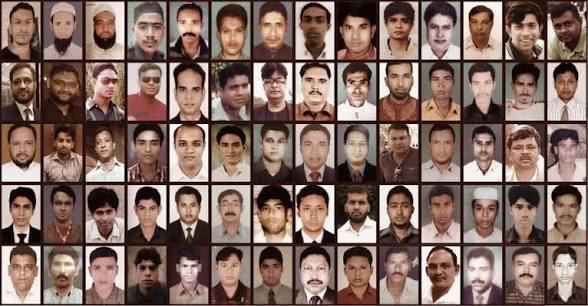
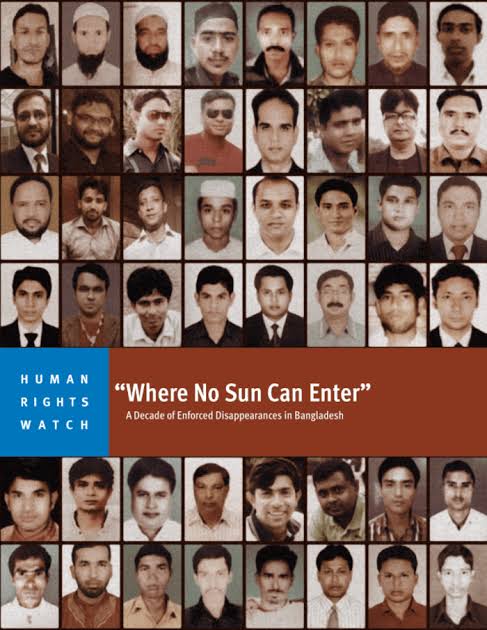
Enforced disappearances in Bangladesh are not isolated incidents; rather, they are a well-planned, institutionalized, and politically targeted practice, the actual extent of which is many times greater than the official record.
A report in the daily Amar Desh on January 5 said that the final report of the ‘Enforced Disappearances Investigation Commission’ mentioned between 4,000 and 6,000 people as victims of enforced disappearances from 2009 to 2024. After scrutinizing 1,913 complaints made to the commission, 1,569 were identified as ‘probable’ cases of enforced disappearance, which is estimated to be only one-fourth to one-third of the actual number.
Calling the report a historic work, Chief Advisor Dr. Muhammad Yunus said, “It is a documentation of how low people can stoop, how demonic they can be, how horrible they can be.”
The Commission of Inquiry into the disappearances submitted its final report to Chief Adviser Dr. Muhammad Yunus on Sunday (January 4). The commission submitted its report at the State Guest House Jamuna in the afternoon.
The commission said that a total of 1,913 complaints were submitted to the Commission for the Investigation of Disappearances. Of these, 1,569 complaints were considered as disappearances according to the definition after scrutiny. Of these, 287 complaints fell into the ‘missing and dead’ category.
“Many people are still coming forward with complaints,” said commission member Nabila Idris, adding, “The number of missing people could be four to six thousand. If we contact many of the missing people, we can find more victims through them, who have not contacted us, do not know about us, or have moved to other countries. There are many people with whom we contacted ourselves, but they did not agree to talk on the record.”
The commission members said that the enforced disappearance was primarily politically motivated. They said that the information we have received proves that this is a politically motivated crime.
The commission said in its report that of the missing persons who have returned alive, 75 percent are Jamaat-Shibir leaders and activists, 22 percent are BNP and its affiliated organizations. Of those who are still missing, 68 percent are BNP and its affiliated organizations leaders and activists, and 22 percent are Jamaat-Shibir leaders and activists.
Evidence has been found of the direct involvement of recently ousted Prime Minister Sheikh Hasina, her Defense Advisor Major General (retd) Tariq Ahmed Siddique, and then Home Minister Asaduzzaman Khan in high-profile disappearances. Notable among the cases are the disappearances of BNP leaders Ilyas Ali, Hummam Quader Chowdhury, Salahuddin Ahmed, Chowdhury Alam, Jamaat leader former Brigadier General Abdullahil Aman Azmi, Barrister Mir Ahmed Bin Quasem, and former Ambassador Maruf Zaman.
The commission members said that Sheikh Hasina herself was the direct orderer in many cases of disappearances. Moreover, the information received about the rendition (secret transfer without legal process) of disappeared victims to India makes it clear that these were done on the orders of the highest levels of the government.
The commission said that according to the investigation, the Baleshwar River in Barisal has witnessed the highest number of murders and disappearances. Hundreds of victims of disappearances were killed and thrown into this river. In addition, evidence of bodies of disappeared persons being thrown into the Buriganga River and Munshiganj has also been found during the investigation.
Regarding the final report of the Disappearance Commission, Commission Chairman Justice Mainul Islam Chowdhury told Amar Desh, “We have been working for a long time for one year and three months on the issue of victims of enforced disappearances in the country at various times. Our team has worked tirelessly to uncover the real information. We have handed over the complete report to the appropriate authorities by following the due process.”
In response to a question, the commission chairman said, “We hope the government will implement our recommendations so that the families of the victims of disappearances get justice.”
Complaint settlement
The report said that out of 1,569 verified complaints filed with the commission, 1,282 have reappeared after being unlawfully detained. On the other hand, there is clear evidence of 287 deaths, of which 251 are permanently missing and 36 bodies were recovered from the river in the ‘crossfire’ or bullet wounds. One in six victims of disappearance is still missing. 98.5 percent of the victims are men. However, the disappearance of women is much less reported due to social fear and shame.
Political targeting is clear.
The analysis of the political identities of the disappeared victims reveals extreme bias. Of those whose political identities have been confirmed (948 people), 96.7 percent are affiliated with various opposition parties and their affiliates. Only one disappeared victim is mentioned as being affiliated with the then ruling party.
The report said that enforced disappearances are closely linked to political pressure and electoral situations. The number increased from 10 incidents in 2009 to a peak of 215 in 2016. The number of enforced disappearances increased during the BNP-Awami League clashes in 2013 and in the run-up to the 2018 elections. The report also highlighted the misuse of enforced disappearances in the name of counter-terrorism operations after the 2016 Holey Artisan attack. However, since 2017, there has been an increasing trend of detention and later return rather than permanent disappearances.
Who is responsible?
The Rapid Action Battalion (RAB) was blamed in 25 percent of the complaints. The police were responsible in 23 percent of the cases and the Intelligence Bureau (DB) in 14.5 percent of the cases. While the names of DGFI and NSI were mentioned less, the report said that in many cases the victims could not recognize the names of the agencies due to their strict confidentiality. In 7.6 percent of the complaints, it was mentioned that people with vague identities called ‘administration people’ were abducted. Joint operations between RAB, DB and police are also noteworthy, indicating a coordinated institutional practice rather than isolated incidents.

Sitting Home Minister Salahuddin Ahmed, Elias Ali, Chowdhury Alam, Sajedul Sumon and hundreds more were directly abducted victims of such heinous tactics. A national trauma centre a call of our time right now.
Complexity and human tragedy
Of the 1,682 other complaints, 113 could not be brought under the definition of enforced disappearance. In one example, it is said that even though a young man died naturally, RAB detectives encouraged the family to file a false murder case by misleading them. As a result, the family suffered for a long time. The young man’s sister told the commission, “I deeply examine every man on the street who looks like my younger brother, just in case it is him.” Even in one disappearance case, DNA tests found the remains of a completely different person after digging up a grave.
Well-planned arrangement
The report said that the practice of disappearances, given its length, scale and adaptability, was not an accident or an isolated incident. It could not have persisted without high-level political knowledge and approval. Coordination between central leadership and agencies made this system possible.
The commission’s commentary states that the enforced disappearances of the Awami League era are best understood not as aberrations but as tools of governance.
The report of the Commission of Inquiry establishes enforced disappearances in Bangladesh as a horrific, well-organized and politically motivated institutional terrorism. It calls for urgent legal and institutional reforms and accountability to eliminate them.
Earlier, on June 4 last year, the Commission of Inquiry into Disappearances submitted its second interim report to Chief Adviser Dr. Muhammad Yunus. Even before that, the Commission submitted its first investigation report on December 15, 2024. It said that the Commission of Inquiry into Disappearances found evidence of Sheikh Hasina’s involvement as an orderer in various disappearances that occurred in the country in the last 15 years. In addition, the names of senior officials involved in the disappearances were revealed in the report, including Tariq Ahmed Siddique, former NTMC Director General Major General (dismissed) Ziaul Ahsan, police officers Monirul Islam and Mohammad Harun Or Rashid.