Bangladesh, may be one of the most fortunate nations on earth since she was blessed some best sons of soil- Ziaur Rahman, the founder of SAARC, Begum Khaleda Zia, the first elected female Prime Minister of Muslim world, Dr Muhammad Yunus, Tarique Rahman, Salahuddin Ahmed & now Dr Khalilur Rahaman – the Foreign minister of Bangladesh who has become an icon of world best diplomatic gestures, narrative & approaches & the General Assembly has unanimously elected him as the 81 st President. His first speech has been complimented as one of the best & most popular clips ever in recorded history.His post speech brief was another big blow to the critics to did not vote him.
Foreign Minister Dr. Khalilur Rahman
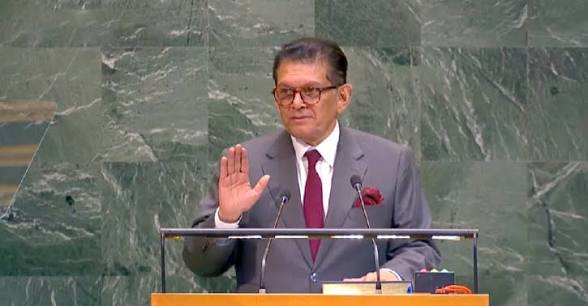
Foreign Minister Dr. Khalilur Rahman delivering a speech as the President of the 81st Session of the UN General Assembly.
Foreign Minister Dr. Khalilur Rahman expressed deep gratitude to Prime Minister Tareq Rahman and Bangladesh while delivering his address as the President of the 81st Session of the UN General Assembly. He conveyed this appreciation late Tuesday night (Bangladesh time). The Foreign Minister also thanked representatives from other nations for their support.
Upon assuming the presidency, he pledged to restore trust in the UN, enhance cooperation and dialogue among member states, and make the institution fit for the future.
Earlier, Dr. Khalilur Rahman told journalists that the UN and the multilateral system as a whole are facing challenges unlike any he has witnessed in his four decades of experience. However, amidst these challenges, new opportunities have emerged for the UN in areas such as new technologies and artificial intelligence. He emphasized that he would prioritize cooperation and dialogue to address these challenges and capitalize on these opportunities.
He noted that not all problems can be resolved quickly or amicably; some issues require time to resolve. Nevertheless, efforts must continue to identify areas of shared interest.
Goal: Making the UN Fit for the Future
Dr. Khalilur Rahman affirmed his commitment to remaining fully faithful to the UN Charter and the mandates given by member states during his presidency. He believes that if member states work together, the prospects for resolving major global crises through dialogue will increase.
He also spoke of continuing the UN reform process. At the same time, he emphasized the importance of more effectively engaging civil society, the media, business and industry leaders, the innovation sector, and academics in the UN’s activities.
He pointed out that the UN Charter begins with the words “We the Peoples of the United Nations”—signifying that it is not merely an organization of member states but also an institution of the people. Yet, there remains a gap in integrating the voices of these key stakeholders into the UN’s work.
As a candidate, his campaign pledge was “Restoring Trust, Managing Transformation.” As President, he has added the goal of making the UN “fit for the future” to this agenda. He aims to build a United Nations where nations can vote in its favor with confidence and enthusiasm.
Commitment to Amplifying the Rohingya Voice
Responding to questions regarding the representation of stateless populations—specifically the Rohingya—Dr. Khalilur Rahman stated that the UN’s concept of “the people” encompasses everyone.
Highlighting his personal involvement in the Rohingya crisis, he noted that, as a high-level representative of the Bangladesh government on Rohingya affairs, he had witnessed their suffering firsthand. He also mentioned organizing an international conference on the Rohingya last year and facilitating the UN Secretary-General’s visit to the Rohingya camps.
He observed that the Rohingya’s greatest aspiration is to return to their homeland, and he pledged to continue championing their cause within the United Nations.
A Common Agenda from World Leaders’ Statements
Regarding the effort to forge a unified stance among member states during the upcoming high-level week of the General Assembly, Dr. Khalilur Rahman emphasized the importance of creating opportunities for world leaders to engage in dialogue.
He intends to call upon heads of state and government to reaffirm their commitments to resolving crises through dialogue and diplomacy, as well as to ensuring development and the welfare and rights of people. He also mentioned plans to identify shared themes in the leaders’ statements to formulate a “common agenda.”
On the Election of the Next Secretary-General
Dr. Khalilur Rahman also addressed the question of whether the next UN Secretary-General should be a woman. He clarified that the authority to elect or appoint the Secretary-General does not rest with him; rather, the process is driven by member states. Under the UN Charter, the Security Council makes the recommendation for the position, and the General Assembly makes the appointment.
He affirmed his commitment to strictly adhering to the Charter throughout this process and expressed his resolve to work closely with member states and the President of the Security Council.
Regarding his priorities upon assuming office, Dr. Khalilur Rahman stated that he aims to steer the 81st session forward through dialogue, cooperation, the rebuilding of trust, and the strengthening of the multilateral system. Oath
Earlier, upon taking the oath as President, he stated, “I solemnly pledge that I will faithfully discharge the responsibilities and functions entrusted to me as President of the United Nations General Assembly with complete dedication, discretion, and conscience. In the performance of my duties, I will be guided solely by the interests of the United Nations and will conduct myself in accordance with the Charter of the United Nations and the Code of Ethics for the President of the General Assembly. I will neither seek nor accept instructions from any government or other source external to the United Nations regarding the performance of these duties.”