The special committee on constitutional amendment aims to move swiftly toward implementing the ‘July National Charter’ exactly as it was signed. To this end, a target has been set to conclude discussions—incorporating the views of political parties and people from various walks of life—and submit a report to the National Parliament by December.
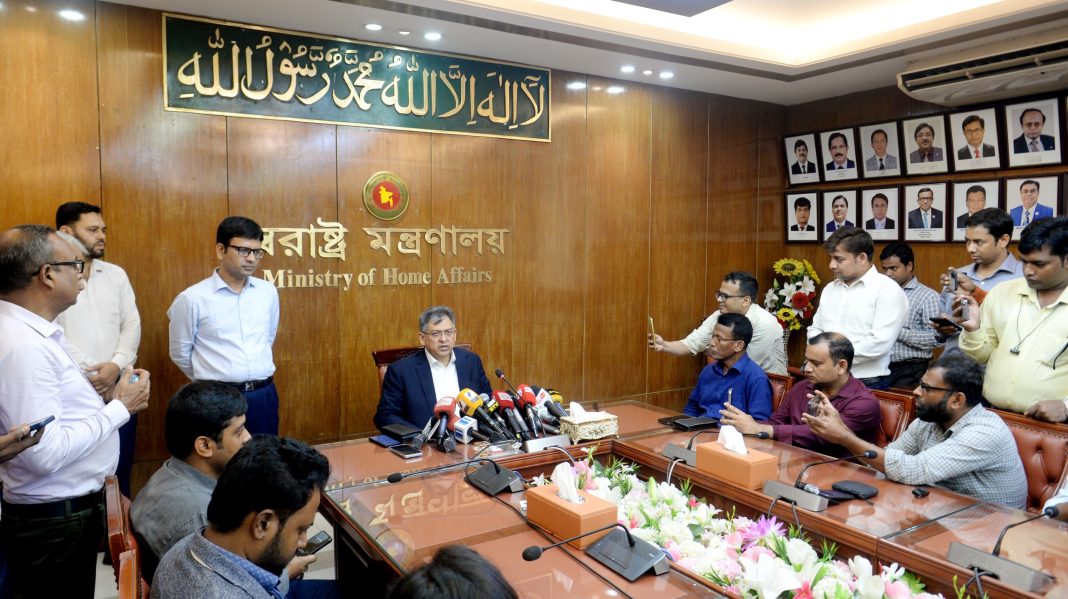
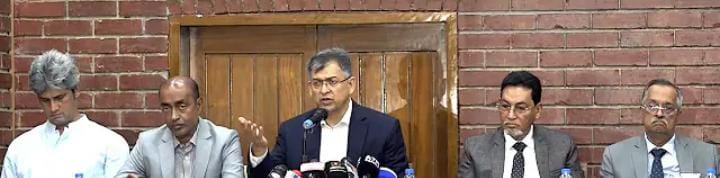
Committee Chairman and Home Minister Salahuddin Ahmed announced this to journalists at the Media Centre of the National Parliament Bhaban today, following the committee’s second meeting. He stated that efforts would be made to hold at least one meeting per week to accelerate the committee’s work.
He said, “The July National Charter will be implemented exactly as it was signed. For this purpose, opinions will be sought from relevant political parties, constitutional experts, former judges and justices, lawyers, teachers, journalists, ‘July fighters,’ representatives of the Anti-Discrimination Student Movement, family members of martyrs, and people from various other professions.”
The Home Minister added that after gathering these opinions, the committee would formulate necessary recommendations for implementing the charter and submit a report to the National Parliament. The committee will also consider any supplementary proposals that are significant to national life, even if they fall outside the scope of the charter itself.
He noted that work on drafting the report has already begun, and it will be possible to present the report to Parliament as soon as the discussions conclude. The committee aims to finish consultations with stakeholders by December.
Salahuddin Ahmed stated that they are committed to implementing the matters on which political parties have reached a consensus. Regarding issues where any party has registered a ‘note of dissent,’ those points will also be taken into consideration alongside the differing opinions.Home Minister’s whole speech has been noted down accordingly here.
“Regarding the 26 political parties that signed the ‘July Charter,’ we invited all of them; I would request the Parliament Secretariat to provide the list of names of those who attended today to any journalist friends who might wish to see it. Representatives from 15 political parties attended—with two representatives each from most, and three from a few—while another party submitted a written statement. A representative from yet another party expressed regret for being unable to attend at the last minute due to illness.
Thus, we can say that approximately 17 political parties participated: 15 attended in person, one sent a written statement, and one could not attend at the last minute due to illness. As for the remaining parties—specifically those who signed the charter but have not yet participated in this Special Committee on Constitutional Amendment due to various demands—they include Bangladesh Jamaat-e-Islami and the NCP. You will also receive a list of the parties that did not sign the July Charter.
A total of 30 parties participated in the discussions with the National Commission. There were three other parties that initially took part but did not continue; consequently, while the official list includes them, we count 30 political parties that actively participated. Among them, four parties signed initially, while the remaining 26 signed on various subsequent dates. As you all know, the ‘July National Charter’ was signed—with a note of dissent—and we made a pledge to implement it exactly as agreed upon. You surely have the document; if you look at page three—under the section titled ‘Matters of Consensus’—you will find Clause 5 (Declaration of Consensus) and Clause 6. Clause 5(a) outlines the consensus reached regarding structural, legal, and institutional changes to the existing governance system—specifically the constitution, electoral system, judiciary, public administration, policing, and anti-corruption measures.
In other words, the signatory parties have affirmed their consensus on these points; there are two additional clauses there that you can review. The subsequent section details the agreed-upon matters, starting with ‘Reforms Subject to Constitutional Amendment’—listing the specific issues to be implemented through constitutional amendments. You will find further details elsewhere in the document.
There are matters—ranging from the 48-point agenda to various reforms requiring laws, ordinances, rules, and executive orders—that are to be implemented subject to necessary amendments; most of these have already been executed, though some legislative work remains. In the context of today’s discussion, I would like to state that many of the political parties that signed the ‘July Charter’ have expressed their views, urging us to conclude discussions and submit the report to Parliament as quickly as possible.
They advocate for adopting the necessary constitutional amendment—specifically, the 18th Amendment—through consensus and consultation with all stakeholders, thereby demonstrating to the nation that the July Charter is being properly implemented. Beyond the July Charter, we also uphold commitments made in our election manifesto—for which the public voted—and these are certainly not issues likely to trigger a negative public reaction. Regarding public interest, for instance, the Cabinet has decided to alter the financial year cycle to ensure the swift and smooth implementation of development projects. Under the current system, the financial year runs from July 1 to June 30; however, the bulk of fund releases and allocations occur in the final quarter—coinciding with the monsoon season—which hinders the efficient execution of development projects, creates financial difficulties, and leads to the wastage or misappropriation of national resources.
To prevent this and align with Bangladesh’s seasonal patterns, we intend to shift the financial year to run from April 1 to March 30. Implementing this change requires amendments to two sections of the Constitution, and several such amendments are forthcoming; indeed, virtually all political parties have unanimously called for the rapid implementation of the July Charter.
We made a promise. We promise here. We will implement the Note of Descent. Since this July the National Charter is the first to be implemented subject to constitutional amendments. which are included in the Constitution. Here, it is clearly written against each clause where notes are given, you will see that if any political party or era gets the people’s mandate by mentioning it in their election manifesto, then they can take action accordingly. For example, we have some recent notes on the composition of the upper house.
For example, the upper house will be formed with 100 members. We agree that many political parties agree. There said how the upper house will be formed? We have said that it will be formed in proportion to the number of seats obtained in the Parliament. Some say because of the proportionality of votes. We have given a note of decision there that if we refer to the manifesto and we get the mandate, then there is another issue in the ratio of seats that the issue of constitutional amendment will be discussed in the upper house. We have not said in the proposal that since the upper house is not directly elected by the people, the issue of amending the constitution will be a matter for the lower side.
Constitutional amendment has not been agreed upon in the note office. Since we have clearly mentioned these issues in our election manifesto, we will go that way. That was the issue of the note of dissent. They said that some political parties are trying to create confusion in field politics by campaigning that because of BNP’s majority they want to implement the July charter which is completely untrue. We have also started the work of preparing the report after accepting everyone’s suggestions. As soon as it is finished, we will be able to present the report to the parliament and based on that report, the constitution amendment bill will come from the ministry of law and from the ministry of parliamentary affairs in the form of a bill.
There was no question of going outside of Dulai. The other thing is that you said that 16 or 17 parties were supposed to come. The opposition party is not yours. Some of the parties who said that they are not here did not come today, so there is no hope of any process being done in the end. 17 is happening. We can call again if we don’t have that meeting today. That’s why I will try to have one meeting every week. >> In some discussions, the political parties give different proposals. As the Constitution Reform Council Commission was formed. Similarly, six commissions were formed.
Judiciary Reform Commission, Administrative Reform Commission, Electoral Reform Commission including Police System, six such commissions were formed. You know, many of the proposals of the Reform Commission were revised during the Inteli Government. The reports of all the commissions were compiled and published in six books. Based on that, the National Consensus Commission was again formed. At that place, the National Consensus Commission will discuss what issues to discuss and later this July the National Charter was enacted.”
Now, it is imperative that national consensus Commission Chairman has provided that a though brief on it & the nation hopes it to be taken accordingly by all parties.