DHAKA — The European Union has called for full legal accountability for the 2024 political violence in Bangladesh, warning that past abuses must be prosecuted alongside sustained institutional reforms to secure the country’s democratic transition.
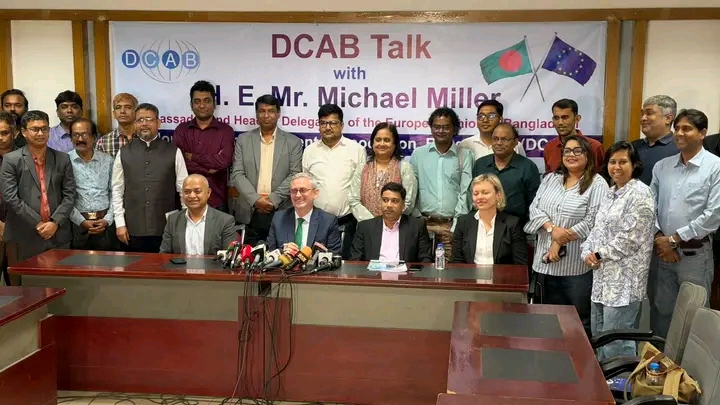
Speaking at the “DCAB Talk” organized by the Diplomatic Correspondents Association of Bangladesh (DCAB) at the National Press Club on Monday, EU Ambassador and Head of Delegation Michael Miller condemned the violence linked to the previous Awami League administration as “in no way acceptable,” adding that the bloc cannot condone the unrest witnessed over the past week.
“The 2024 violence must be prosecuted and reform efforts must be taken forward,” Miller said, urging political parties to collaborate on institutional reform, violence prevention, and democratic consolidation.
Addressing the current security climate, the envoy endorsed the interim authorities’ response to recent unrest, noting that the government has used necessary force to bring the security situation under control. However, he declined to weigh in on domestic political restrictions, stating that the EU maintains no official position on banning the Awami League or lifting restrictions on its activities.
Democratic Transition and Reforms
Acknowledging the complexities of Bangladesh’s political shift, Miller pledged continued European backing. “The path from dictatorship to democracy is not easy. We will continue to provide all-out support and cooperation to Bangladesh in its transition to democracy,” he said, expressing Brussels’ desire to forge a strategic partnership with Dhaka.
He commended the reform commissions established under the interim government for generating “many good ideas” and noted the EU’s readiness to help identify and implement feasible proposals. Emphasizing that stability and prosperity depend on justice, human rights accountability, and the rule of law, Miller also urged all actors to respect public order and avoid further violence.
Responding to questions on human rights, the ambassador noted that Brussels conducts daily monitoring of the situation in Bangladesh, as human rights protections directly influence the scope and ambition of bilateral relations and are regularly scrutinized by the European Parliament and EU member states.
Trade Challenges and LDC Graduation
On economic ties, Miller announced that formal negotiations for a Free Trade Agreement (FTA) between the EU and Bangladesh will commence in December.
He cautioned that Bangladesh’s vital ready-made garment (RMG) sector faces mounting long-term pressures. While the industry currently relies on relatively low labor costs, demographic shifts are expected to drive wages higher, eroding its traditional comparative advantage. Furthermore, Miller noted that regional competitors already enjoy preferential trade deals in Europe.
Once Bangladesh’s post-Least Developed Country (LDC) transition period expires, failure to secure a new trade arrangement with the EU would subject Bangladeshi garment exports to standard Most Favored Nation (MFN) tariffs. To remain competitive, Miller advised early strategic planning, technological modernization, circular economy adoption, and a transition toward renewable energy.
“These changes cannot happen overnight. It will take years to plan, invest, build, and implement infrastructure. So it is important to engage with the EU now on future trade relations,” he said, affirming the bloc’s willingness to partner with the government, private sector, and civil society.
Support for Rohingya Repatriation and Justice
Reiterating the EU’s commitment to resolving the Rohingya crisis, Miller emphasized support for the safe, voluntary, dignified, and sustainable repatriation of refugees to Myanmar. Since 2017, the EU has contributed over €500 million in humanitarian aid—including €31.5 million allocated for 2026—alongside €50 million in ongoing development assistance for Cox’s Bazar.
Citing recent proceedings at the International Court of Justice (ICJ), Miller highlighted EU support for international accountability mechanisms, including efforts to facilitate Rohingya witness testimonies. He added that Brussels is awaiting Dhaka’s updated Rohingya strategy and hopes to see sustained international responsibility-sharing.
DCAB President AKM Moinuddin and General Secretary Imrul Kayes also addressed the event.