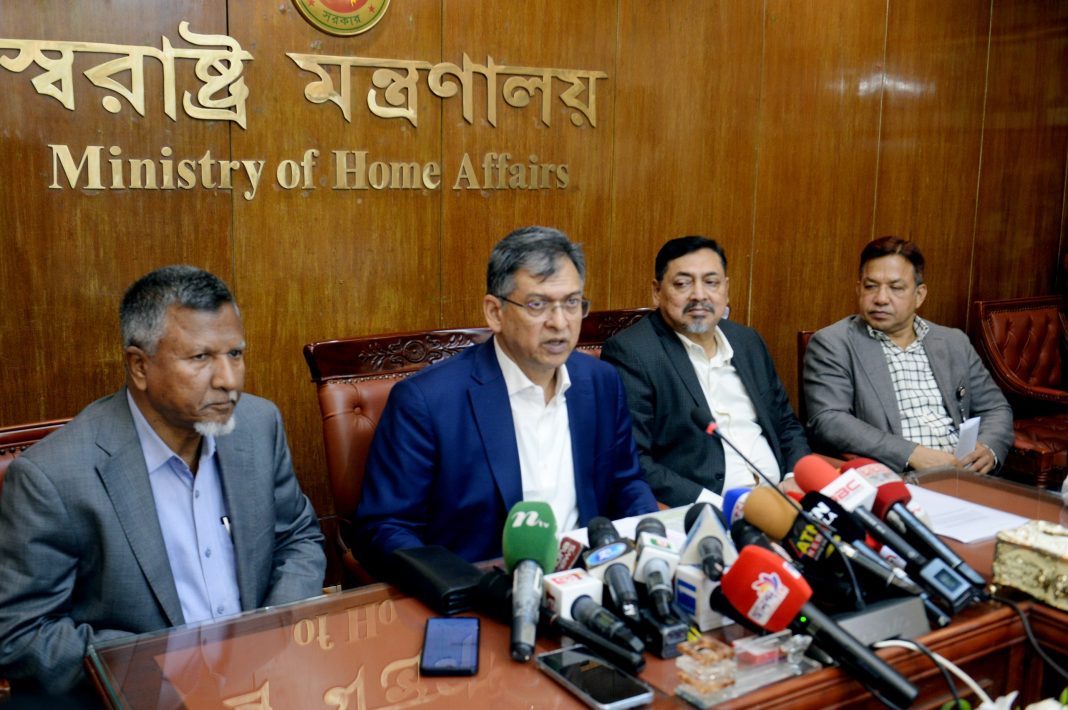
Ershad Nabil Khan Challenges Subir on his outlandish rhetoric on Home minister Salahuddin Ahmed.

Subir Bhaumik’s remarks are not a new argument against Salahuddin Ahmed, but an echo of an old narrative.
We do not view the scathing and sarcastic comments made by Indian journalist Subir Bhaumik regarding Salahuddin Ahmed merely as the personal opinion of a journalist; the political significance runs deeper.
Consider the man who was subjected to enforced disappearance for 61 days during the tenure of the fascist Hasina and Awami League government. Those attempting to construct baseless narratives about his political stance and role today must first answer a fundamental question: in a regime capable of attempting to obliterate a victim of state persecution, is it truly far-fetched to believe that Salahuddin Ahmed’s life was in extreme danger?
For the past two years, a specific political circle has consistently circulated various stories, suspicions, and speculations regarding Salahuddin Ahmed. Attempts have been made to craft a narrative around his political role, India-Bangladesh relations, security, and state policies—narratives largely rooted in conjecture and politically motivated agendas.
However, today’s incident has brought a different aspect to the fore. When an Indian journalist like Subir Bhaumik publicly employs hostile and mocking language against Salahuddin Ahmed, the question arises: why is there such unease?
If a public official clearly articulates Bangladesh’s position on matters of national interest, border security, regional geopolitics, or relations with India, the response should be grounded in logic, facts, and diplomatic language. Personal attacks or ridicule can never substitute for reasoned argument.
And therein lies the political significance of Salahuddin Ahmed’s statements.
He has likely struck a nerve—a point where a reaction of discomfort is only natural. If his words challenge a long-established narrative, it is hardly surprising that the proponents of that narrative would react. Even more significant is the fact that political figures—such as Jamaat MP Masud Saidi and independent MP Rumin Farhana—shared Subir Bhaumik’s statements with the intent of undermining Salahuddin Ahmed; this raises political questions.
It demonstrates just how low they are willing to stoop for the sake of their own interests.
An Indian journalist made a statement against a Bangladeshi minister, and political opponents within Bangladesh seized upon it as a political weapon.
At the very least, this makes it clear that who utilizes whose statements in the political arena serves as a significant political signal.
I do not consider political differences of opinion to be unusual; policy-based debates with parties like Jamaat, the NCP, or others are entirely possible. However, when a hostile statement by a foreign national against a Bangladeshi minister is used merely as a tool to attack a political opponent, the public will inevitably ask: is this politics driven by Bangladesh’s national interest, or is it politics aimed at undermining an opponent?
The greatest weakness of the propaganda, suspicions, and baseless narratives spun around Salahuddin Ahmed over the past two years is that they required a constant stream of new stories and scripts to keep them alive. Yet, in politics, it is not stories but actual stances that ultimately endure.
Furthermore, Salahuddin Ahmed’s 45-year political career, his ordeal of being forcibly disappeared for 61 days, his nine-and-a-half years of exile, and his steadfastness in the face of state persecution—none of this can be erased by a mere social media post.
On the contrary, today’s reactions serve as a fresh reminder of one thing:
Salahuddin Ahmed speaks from a position where his statements hold immense importance not only for Bangladesh’s domestic politics but also for regional geopolitics.
Therefore, if the response to his statements relies on personal ridicule, the vitriol of a foreign journalist, or old narratives concocted by political opponents—rather than on reasoned argument—it reflects not a weakness on Salahuddin Ahmed’s part, but rather the significant political impact of his words.
The ball has hit exactly where it was supposed to, which is why there is such a strong reaction. This means Salahuddin Ahmed is on the right track.

Ershad Nabil khan is consulting editor of daily Bangladesh first.