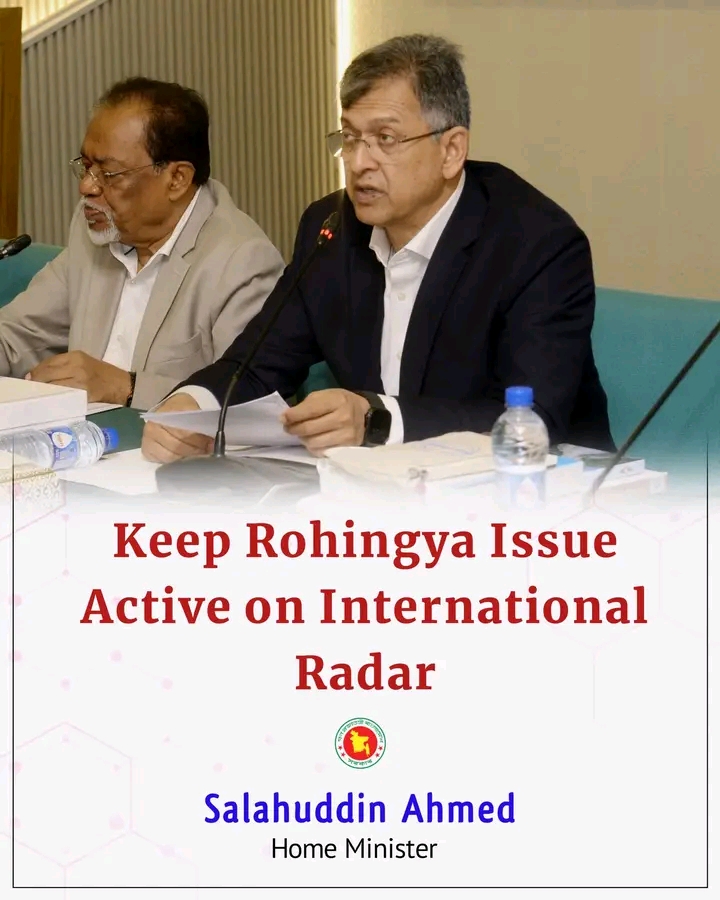
Keep Rohingya Issue Active on International Radar: Home Minister
Dhaka, (06 September, 2026):
Home Minister Salahuddin Ahmed has stated that a quick and sustainable political solution to the Rohingya crisis must be ensured through robust cooperation from the global community and international organizations. Appealing to the international community, including the United Nations, he stressed that the Rohingya issue must remain active on the UN’s international radar and not be overshadowed by other global political conflicts or crises. He emphasized that the prompt and dignified repatriation of Rohingya refugees to their homeland in Myanmar must be ensured through joint efforts and effective diplomacy by the international community.
The Minister made these remarks as the Chief Guest today during a roundtable discussion titled “The Rohingya Crisis: Emerging Challenges & Reframing Response Strategies,” organized by the Institute for Global Cooperation Foundation (IGCF) at the Bangladesh Institute of International and Strategic Studies (BIISS) auditorium in the capital.
Speaking as the ‘Guest of Honor’ at the event, Md Ismail Zabihullah, Advisor to the Prime Minister on the Ministry of Public Administration, highlighted the importance of administrative coordination regarding the Rohingya issue.
In his address as the Chief Guest, the Home Minister stated that a permanent and sustainable solution to this crisis is possible with the direct assistance of major powers in global politics and the United Nations. He called upon all relevant parties, including international human rights organizations and the UN Refugee Agency (UNHCR), to play a more effective role in resolving the Rohingya crisis. He remarked, “Our primary objective is one—to repatriate the nearly 1.5 million (1.2 million according to UNHCR) Forcibly Displaced Myanmar Nationals (FDMNs) to their homeland with full dignity and safety. To achieve this, continuous assistance from the international community and the political engagement of major powers are vital.”
Highlighting the long-term impacts of the crisis, the Minister stated that for nearly nine years, Bangladesh has been providing shelter, food, land, medical care, and essential livelihood security to over 1.5 million displaced Rohingyas on humanitarian grounds. However, over time, criminal activities, arms and drug smuggling, human trafficking, gender-based violence, and the activities of armed groups have increased in the camps, posing severe challenges to Bangladesh’s internal security. Noting that the lives and environment of the adjacent local host communities have been severely compromised, he said that necessary security measures, such as perimeter fencing around the camps and controlled movement systems, are imperative to control crime and ensure the overall security of both the Rohingya population and local citizens.
Recalling Bangladesh’s historical experience, the Minister stated that under the successful leadership of the late President Ziaur Rahman in 1978 and the visionary diplomatic initiative of former Prime Minister Begum Khaleda Zia in 1992, Bangladesh successfully completed the repatriation of Rohingyas to Myanmar. Capitalizing on those past successful experiences, the current government, under the dynamic and visionary leadership of Prime Minister Tarique Rahman, is determined to execute a fully successful repatriation once again.
The Minister added that under the dynamic leadership of Prime Minister Tarique Rahman, the ‘National Strategy Formulation Committee on Rohingya Affairs’ has already been formed. Furthermore, another high-level national committee led by the Home Minister is actively functioning to oversee law enforcement, border management, and overall coordination. He mentioned that the government is operating under a comprehensive ‘Whole-of-Government’ approach involving civil administration, security, and defense agencies.
The Home Minister warned that providing indefinite humanitarian assistance without a specific and credible repatriation plan could reduce the urgency for a long-term political solution. Therefore, moving beyond emergency relief, we must rapidly shift to a transitional strategy aimed at creating a safe and conducive environment for return in Myanmar’s Rakhine State.
At the meeting, the Home Minister expressed optimism that through sustained international participation, national unity, and a strong security framework, Bangladesh will soon be able to achieve the dignified and permanent repatriation of the Rohingyas to their homeland.
The roundtable discussion began with welcome remarks from Chowdhury Adnan Rahman, Chief Executive Officer (CEO) of IGCF. The entire program was moderated by Dr. Bulbul Siddiqi, Professor of the Department of Political Science and Sociology, North South University.
Among others who spoke at the roundtable discussion were Ivo Freijsen, UNHCR Representative in Bangladesh; Major General A S M Ridwanur Rahman, Director General of BIISS; Mohammed Mizanur Rahman, Refugee Relief and Repatriation Commissioner (RRRC); Mohammad Nazmul Abedin, Head of the Refugee Cell and Joint Secretary, Ministry of Disaster Management and Relief; Professor Dr. Sazzad Siddiqui, Chairman, Department of Peace and Conflict Studies, Dhaka University; Professor Dr. Niloy Ranjan Biswas, Department of International Relations, Dhaka University; Dr. Kazi Mahmudur Rahman, Professor, Department of Social Sciences & Humanities, Independent University, Bangladesh (IUB); Professor Dr. Nurul Huda Sakib, Jahangirnagar University; Abanti Harun, Assistant Professor, ULAB; Farah Kabir, Country Director, Action-Aid Bangladesh; and Raheed Ejaz, Special Correspondent, The Daily Prothom Alo.