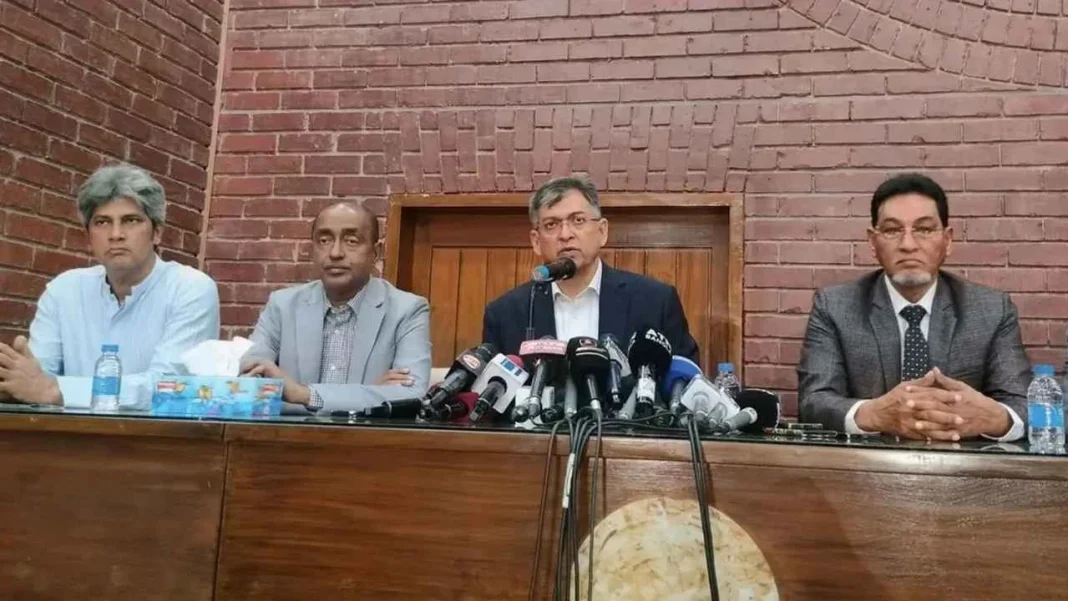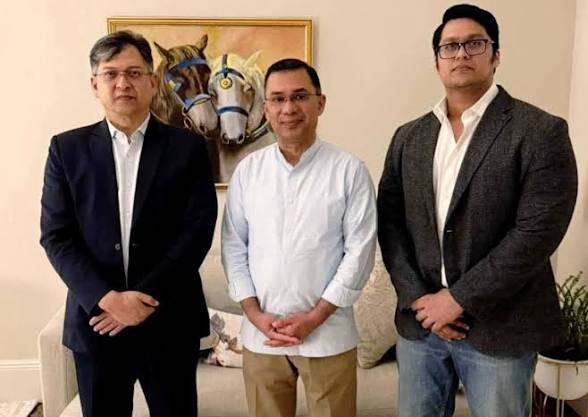
Sayeed Ibrahim Ahmed has been one of the focal points of debate, discourse, discussion & seriously Unverified & uncross checked information and abstract ideas. He has been a faculty business administration in American International University for more than seven years. Owing to his deepest passion for Cricket, he joined Bangladesh cricket board and now attacks on him has increased exponentially on a large scale, here we have discussed its pros & cons.
Nasiruddin Patuary & Asaduzzaman Fuad two spokesmen of NCP & AB party who are most notorious for populist narratives within conservative youths & diaspora. These two men indeed initiated this smear campaign which ultimately was followed by many other social media campaigners. It’s extremely disheartning to witness that in Bangladesh, facts hardly matter but falsehood does matter a lot & Sayeed Ibrahim Ahmed has become a victim of such a smear campaign.

“Salahuddin Ahmed’s son hasn’t done even four taka’s worth of development work in Bangladesh, yet he secured a contract worth 400 crore taka.”
This demonstrates how a completely outrageous narrative is being constructed by blending half-truths, misinformation, and politically motivated framing. First and foremost, Sayeed Ibrahim Ahmed did not secure any government contract. He was not awarded a contract for any government project, nor did any ministry assign him work. He did not win a government tender to undertake a project worth 400 crore taka.In fact, the reality is quite the opposite.
On his own initiative, he persuaded a Japanese construction company—Miyagawa Kensetsu—to invest in Bangladesh, specifically regarding the construction of two major bridges. According to published reports, Miyagawa Kensetsu has expressed interest in the Barishal-Bhola and Chandpur-Shariatpur bridge projects, with Stallion Capital identified as their local partner.
The core issue here is not securing a government contract, but rather bringing foreign investment into Bangladesh. To grasp this, one must understand the basic structure of business operations.
If a foreign company wishes to invest its own funds in an infrastructure project in Bangladesh, it may require a local partner, investment advisor, consultant, or development partner to facilitate business operations within the country. Stallion Capital presents itself as the local partner and investment consultant for Miyagawa Kensetsu.
Here, the act of securing a government contract has been deliberately conflated with the act of bringing in foreign investment. This is the essence of the propaganda; this is disinformation.
Consider this scenario: an entrepreneur brings an investment of $1 billion from abroad into Bangladesh. Does that make them a government contractor for that $1 billion? The answer is no. He has brought in investment.
A foreign company will enter a project based on its own capital, business plan, and investment structure. Meanwhile, a local partner may receive fees, commissions, or success fees designated for their professional role—provided such arrangements are contractual and lawful. Therefore, claiming someone “secured a contract worth 400 crore Taka” is not the same as being part of a business agreement to earn a potential commission or fee by facilitating foreign investment.
And the most important question is: who stands to benefit if this investment comes to Bangladesh?
Sayeed Ibrahim alone? No!
The entire people of Bangladesh will benefit.
The construction of the Barishal-Bhola Bridge would revolutionize the communication system of the southern region. A bridge between Chandpur and Shariatpur would facilitate direct connectivity between the southwestern and southeastern regions. According to published project data, the combined estimated cost of these two bridges is approximately 33,423 crore Taka; their implementation could significantly impact trade, connectivity, investment, and employment in the southern region.
In other words, what is being portrayed through political propaganda as merely “securing a 400-crore Taka contract” actually encompasses foreign investment, infrastructure development, improved connectivity, job creation, and the economic potential of the southern region.
Now, let us address another crucial point.
Ibrahim himself previously wrote that he had secured business worth 100 crore Taka during his tenure at UCB. If we take that claim regarding his professional experience into account, the assertion that “he hasn’t even done 4 Taka worth of development work in Bangladesh” simply does not hold water.
Essentially, the accusers are simultaneously dismissing his past professional achievements and attempting to mischaracterize his initiative to attract foreign investment as a standard government contracting job.
This is not criticism; it is a distortion of facts intended to politically disparage an individual. Furthermore, there is another aspect of this matter that I find significant: I consider Sayeed Ibrahim to be a very promising leader. If a young person—drawing on experience in international education, finance, investment, infrastructure, and business—attempts to bring foreign investment to Bangladesh, it is certainly legitimate to question them. One can—and indeed should—scrutinize the transparency of their work, the structure of their agreements, commissions, and potential conflicts of interest. However, asking questions is not the same as spreading malicious propaganda.
Making unsubstantiated allegations about securing government contracts, mischaracterizing foreign investment as mere government procurement work, and weaponizing a young entrepreneur’s family background for political gain—none of these are hallmarks of healthy political discourse.
In fact, this reveals a major weakness in the politics of the NCP-Jamaat camp: attempting to put someone on the back foot through character assassination and smear campaigns simply because they lack the arguments to counter them politically.
They likely believe that by keeping Ibrahim on the defensive from the start, it will be easier for their own incompetent, good-for-nothing figures to project themselves as major players. But politics is not that simple.
Qualities such as competence, education, professional expertise, international connections, and the ability to attract investment cannot be obscured by propaganda for long. A person’s worth is not measured merely by whether they have executed a minor development project worth a pittance.
Instead, the questions should be:
What is he bringing to Bangladesh? What kind of investment is he securing? How much employment is he generating? What role is he playing in the country’s infrastructure development? And how transparent and lawful are his business transactions?
Ask these questions.
Present evidence if you have it.
Investigate if there is any wrongdoing.
However, attempting to politically suppress a promising young individual through baseless, crude, and misleading propaganda—such as the claim that “he secured a contract worth 400 crore taka despite not having done even 4 taka’s worth of work”—only exposes the political bankruptcy of the propagators themselves. What Bangladesh’s politics needs right now is a competition of competence, not a competition of smear campaigns.
The author Ershad Nabil khan is a consulting Editor of daily Bangladesh first and a youth leader of Bangladesh Nationalist Party. Ahmed Saikat, Executive editor of daily Bangladesh, published its modified version for greater understanding of foreign & English readers.