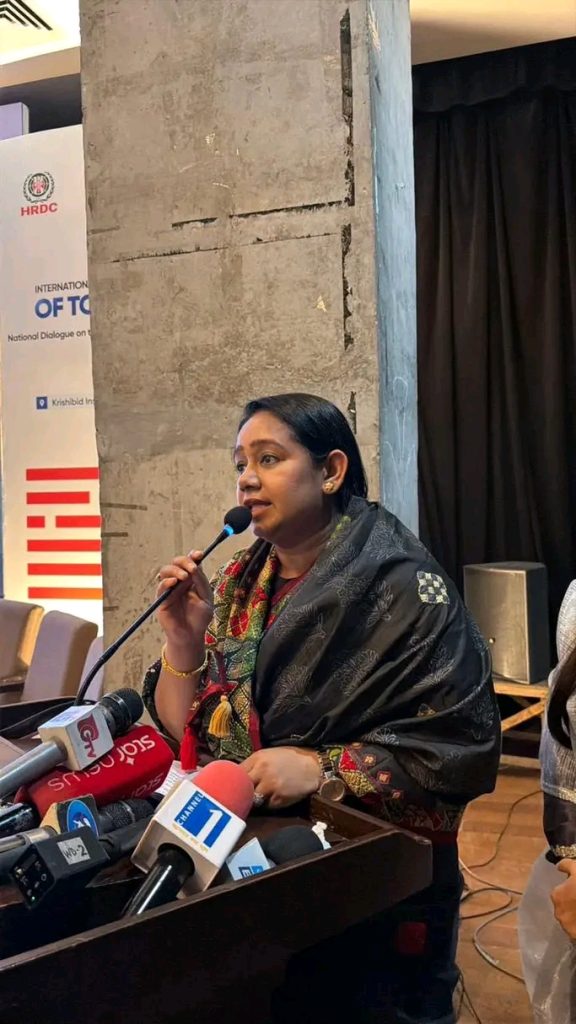
Marking the United Nations International Day in Support of Victims of Torture, Maayer Daak, together with the Human Rights Development Centre (HRDC), convened a national dialogue titled “National Dialogue on the Right to Reparation and Rehabilitation” at the Bangladesh Agricultural Institute (KIB) in Dhaka.
The event created a platform where survivors of torture, families of victims of enforced disappearance, those injured during the July Movement, Members of Parliament, lawyers, academics, human rights defenders, and civil society representatives discussed the urgent need for a comprehensive victim-centred justice system in Bangladesh.
Throughout the dialogue, participants stressed that accountability cannot be limited to criminal trials alone. They argued that victims and their families require long-term rehabilitation, psychosocial care, financial assistance, and formal recognition of their suffering. To achieve this, they urged the government to adopt a National Victim Charter, establish a Parliamentary Human Rights Committee with balanced representation from both the government and opposition, and create an independent National Preventive Mechanism (NPM) to prevent torture and enforced disappearance. Participants also called for strengthening the independence and capacity of the National Human Rights Commission.
Opening the programme, Member of Parliament Sanjida Islam Tulee MP acknowledged the decades of pain endured by families searching for their disappeared loved ones. She emphasized that the state has a responsibility not only to investigate these crimes but also to provide meaningful support and protection to affected families.
Professor Muhammad Asadullah of the University of Regina presented a policy paper entitled “Supporting Life After Torture,” outlining practical recommendations for institutional reform. His proposals included adopting a National Victim Charter, establishing a cross-party parliamentary committee on human rights, and introducing an effective National Preventive Mechanism in accordance with the Optional Protocol to the Convention Against Torture (OPCAT) and the Paris Principles.
One of the most powerful moments of the event came during the testimony session, where survivors of enforced disappearance, relatives of disappeared persons, and victims of torture during the July Movement shared their personal experiences. Their stories reflected years of uncertainty, trauma, financial hardship, and social exclusion while highlighting the urgent need for truth, justice, reparations, rehabilitation, and guarantees that such abuses will never occur again.
During the discussion, Members of Parliament Abdullah Al Amin, Anisur Rahman, Tahsina Rushdir Luna, and Barrister Mir Ahmad Bin Quasem emphasized the importance of effective investigations, victim-centred legal processes, and stronger state institutions capable of preventing future human rights violations. They reaffirmed that justice must remain a national priority.
Chief Prosecutor of the International Crimes Tribunal Md. Aminul Islam said that since assuming office he has considered himself part of the struggle of families affected by enforced disappearance and the July Mass Uprising. He reaffirmed his commitment to ensuring accountability through the ongoing judicial process.
Human rights lawyer Nur Khan Liton emphasized that restoring victims’ dignity requires more than court verdicts. He called for sustained psychosocial support, preservation of DNA samples from relatives of disappeared persons to facilitate future identification, and comprehensive investigations into alleged secret detention facilities.
The dialogue was chaired by Deputy Speaker of the National Parliament Barrister Kayser Kamal, who declared:
“The time for mourning has passed. Now is the time to secure justice and claim our rights.”
He called for stronger institutional protection for families of victims and urged all democratic forces to stand together against torture, enforced disappearance, and other grave human rights violations.
Addressing the event as Chief Guest, Minister for Local Government, Rural Development and Cooperatives Mirza Fakhrul Islam Alamgir said that the government is committed not only to discussing these issues but to implementing practical measures. He described enforced disappearance as a crime against humanity and affirmed that there should be no political division regarding justice for victims. He also stated that families of victims of enforced disappearance deserve consideration for state assistance similar to that provided to freedom fighters and those affected during the July Movement.
HRDC Secretary General Md. Mahbul Haque urged the government to translate the dialogue’s recommendations into concrete policy reforms, particularly through the adoption of a National Victim Charter, establishment of a Parliamentary Human Rights Committee, and creation of a National Preventive Mechanism.
Closing the programme, Hazera Khatun of Maayer Daak thanked the victims, survivors, family members, speakers, Members of Parliament, and all participants for their solidarity and reaffirmed Maayer Daak’s continued commitment to standing beside families seeking truth, justice, and dignity.
Maayer Daak believes that genuine justice requires a holistic approach that combines accountability with truth, reparations, rehabilitation, institutional reform, and guarantees of non-recurrence. The organization hopes that the recommendations emerging from this national dialogue will encourage the Government of Bangladesh to establish a comprehensive national framework that recognizes the rights and dignity of all victims of torture and enforced disappearance.
।
।
।