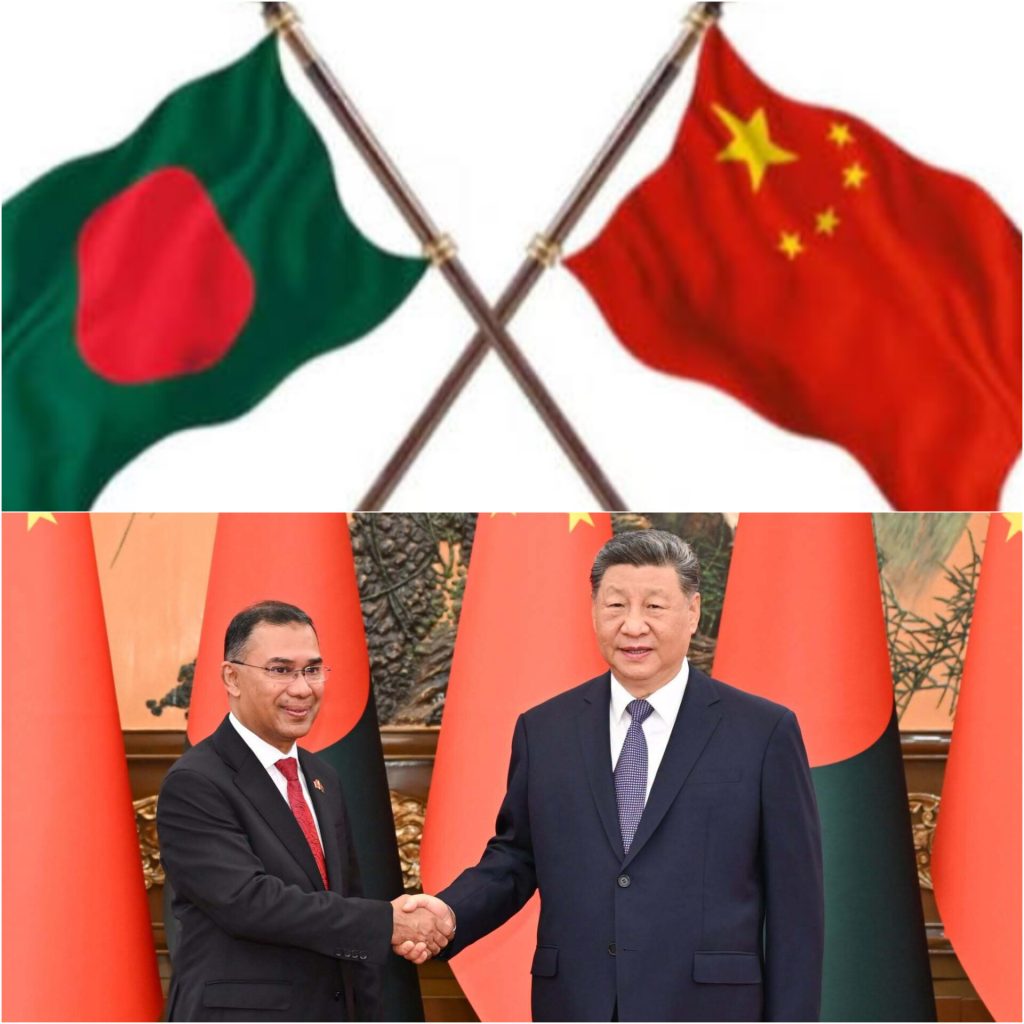
The economic and diplomatic relations between Bangladesh and China have reached a historic turning point this year while BNP has taken the lead. The BNP government’s policy shift in foreign policy has impressed geostrategic thinkers and policy makes a like.
In continuation of this, Chinese Ambassador Yao Wen said that the upcoming visit to Bangladesh by Vice President of China International Development Cooperation Agency (CIDCA), Minister of the International Department of the Central Committee of the Communist Party of China and Executive Vice Governor of Yunnan Province will make this investment and diplomatic blueprint a reality. If the right planning and effective policies are adopted, Chinese investment will become the main economic driving force for Bangladesh in the future.
Diplomatic and economic analysts say that Chinese investment does not only mean strengthening diplomatic relations; it can also have an impact on the economy. Because Bangladesh is now standing at a time when investment, employment, export diversification and technology transfer are four very important things for the economy. If Chinese investment comes, Bangladesh can get three major benefits; first, new industries; second, skilled manpower; third, technology and management knowledge.
According to BIDA and the Ministry of Foreign Affairs, a Chinese economic and industrial zone is being built on about 800 acres of land in Anwara, Chittagong. After a long period of complications, its construction officially began in July 2026. The Bangladesh government has approved a project to spend Tk 4,189 crore to develop the necessary infrastructure of this industrial zone. Of this, about Tk 2,467 crore is expected to come through preferential loans from China. The project includes roads, bridges, electricity, gas, water, waste and wastewater management, and jetty facilities for industries. The location of this industrial zone is also very important. It is near the Karnaphuli Tunnel, about 12 kilometers from Chittagong Port, and about 7 kilometers from Shah Amanat International Airport. As a result, the industrial zone has the potential to become a major manufacturing and export-logistics hub centered on Chittagong in the future.
Chinese Ambassador Yao Wen said that the ties between Bangladesh and China are long-standing and strong. Prime Minister Tarique Rahman’s visit to China has consolidated the foundation for building a community of shared future for the two countries. More than 110 Chinese companies have already visited this industrial zone and more than 30 companies have expressed interest in investing. The potential investment is about 500 million US dollars and there is a possibility of creating more than 100,000 direct and indirect jobs from these investments. On the other hand, according to BIDA information, if the industrial zone is fully developed, there is a possibility of investment of about 1.3 billion US dollars and more than 100,000 jobs.
Another important area of Chinese cooperation is Mongla Port. The two countries agreed to take forward the project to modernize and expand the Mongla Port facility in a meeting with State Minister for Foreign Affairs Humayun Kabir. On August 30, Ambassador Yao Wen also informed the State Minister of Foreign Affairs about the progress in this regard. If the capacity of Mongla Port increases, it may have an impact not only on the southwestern region, but also on the overall import-export system of the country. If opportunities are created for the rapid transportation of industrial and agricultural products of the southwestern region including Khulna, Jessore, Barisal, the possibility of setting up new industries will also increase.
According to sources in the Ministry of Foreign Affairs and BIDA, the possibility of setting up high-tech industries including electric vehicles, batteries, medical equipment, along with ready-made garments and textiles in the Chinese Economic and Industrial Zone (CEIZ) has been discussed. The Bangladesh government has also called on Chinese investors to invest in semiconductors, high-tech and strategic industries.
According to Bangladesh Bank data, China has become one of the largest FDI sources in Bangladesh in 2025. As of September 2025, about 8.78 percent of Bangladesh’s FDI stock was from China; if Hong Kong is taken separately, the share of Chinese sources is even larger. The picture of Bangladesh’s EPZs also speaks for itself. In the fiscal year 2025-26, ‘BEPZA’ has signed investment agreements with 36 companies, of which 23 are Chinese-owned or Chinese joint ventures. The proposed investment amount of these companies is about $ 498.86 million.
Prominent political scientist and international relations analyst and professor of the Department of Political Science at Shahjalal University of Science and Technology, Dr. Nazrul Islam said, the real success of Chinese investment should not be measured only by how many dollars are invested. We need to see how many products Bangladesh is able to produce and export to third country markets including China from this investment. If Bangladeshi factories can be connected to the international supply chain of Chinese companies, the potential for exports of ready-made garments as well as electronics, shoes, light engineering, plastics, medical equipment, batteries, electric vehicle parts and renewable energy equipment can increase. He said, not only investment but also our military and technological relations with China need to be strengthened. It is important to connect Bangladesh with high-tech industries made in China.
The goal of economic cooperation is quite clear in the speech of Chinese Ambassador Yao Wen. At the groundbreaking ceremony of the China Economic and Industrial Zone (CEIZ), he said that the industrial zone will help strengthen Bangladesh’s industrial and supply chain, increase export capacity and create jobs for local people. He also said that China is ready to work with Bangladesh to accelerate the construction of the industrial zone and attract more high-quality Chinese enterprises.
State Minister for Foreign Affairs Humayun Kabir said that China is an important development partner of Bangladesh and the new diplomatic platform will be positively utilized to further strengthen the relations between the two countries. He said that the foundation for a ‘2+2’ dialogue on diplomacy and defense with China is being laid and it will be started at a mutually convenient time. At the same time, the two sides also discussed the early start of a foreign minister-level strategic dialogue. There is also economic importance here. Because if high-level strategic dialogue is held regularly with a country, it is easier to bring investment, trade, infrastructure, technology, energy and regional connectivity issues into a long-term policy framework.
Prominent senior diplomat and international relations expert Shakib Ali believes that relations with China are becoming more important for Bangladesh, especially in the post-LDC trade reality. According to him, China is one of Bangladesh’s largest trading partners and the transformation of global supply chains is offering new opportunities to Bangladesh. He said that increased Chinese investment could help Bangladesh create jobs, transfer technology, earn foreign exchange and diversify exports. According to him, in this regard, the Chinese Economic and Industrial Zone (CEIZ) in Anwara can be a major catalyst for industrialization. Strategic analysts at the Bangladesh Institute of International and Strategic Studies (BIS) also shared the same view.