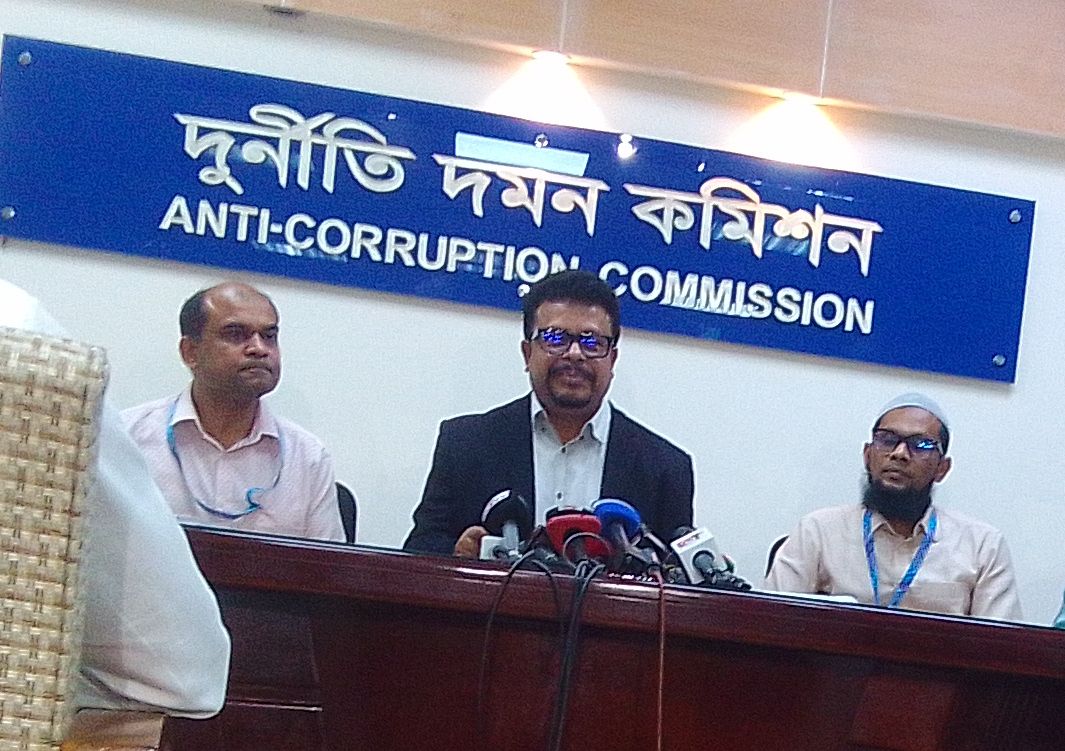
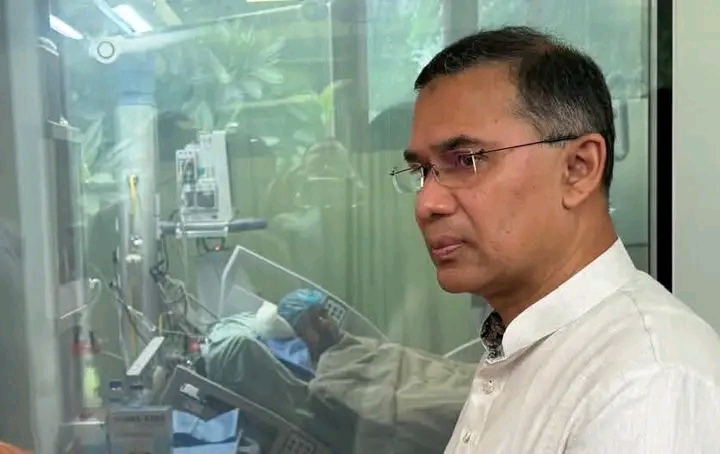
Shamsul Alam, the senior secretary, who was branded as a cyber militant by fallen & fled fascists for last 16 years, sacrificed much of his legacy for emancipation of freedom loving people & today it is time, officials like him be honoured accordingly- here is an urgent call from Ahmed Saikat, editor of daily Bangladesh first, son of Cox’s Bazar like adored Home minister Salahuddin Ahmed.
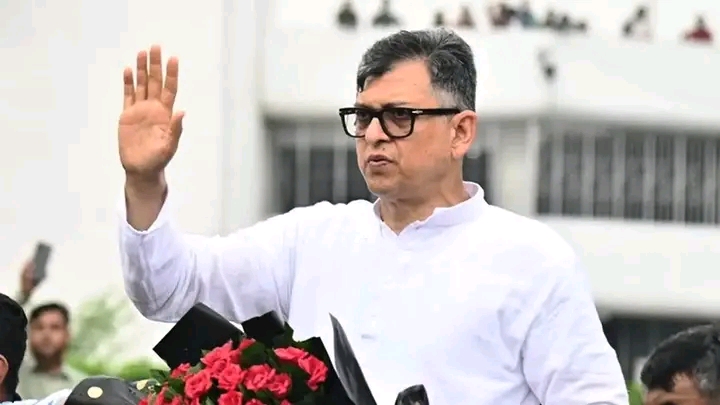
“You take my dead body back”—I had said; “You will return and lead the country.”
The lives of some people cannot be described merely as a “biography.” A biography lists dates of birth, educational details, employment history, and official titles. Yet, a person’s true life story is written elsewhere—in how many times they broke down and rose again, how much darkness they traversed, and whether they managed to keep their inner light alive amidst that darkness.
Salahuddin Ahmed is one such man.
A look at his life reveals a panorama of Bangladesh’s politics over the last four decades: a brilliant law student at Dhaka University; Acting Central President of Chhatra Dal; a lawyer; a BCS Administration cadre officer and magistrate; Assistant Private Secretary to Prime Minister Begum Khaleda Zia; a young leader who left government service for electoral politics; a Member of Parliament; a Minister; a public representative deeply involved in the development of Cox’s Bazar; a BNP spokesperson; an imprisoned political leader; a victim of enforced disappearance; an exile in Shillong; a member of the party’s National Standing Committee; and finally, a Home Minister returned through the people’s mandate.
Few people embody so many different identities in a single lifetime.
That is precisely why Salahuddin Ahmed should be judged not by his titles, but by the path he has traversed.
I came to know him through significant chapters of his political career. We were colleagues at Prime Minister Begum Khaleda Zia’s office for over four years. He was my senior by two batches, and the nature of our work was quite similar. In the workplace, I found him to be an incredibly hardworking individual, while in personal interactions, he was a thorough gentleman.
I mention this personal memory because, amidst the storms that later buffeted his political life, this recollection served as my primary yardstick for understanding the man himself.
It was a day in December 1995.
He said to me, “I’m going to contest the election. Can you get my resignation accepted within a day?”
I replied, “I can.”
However, I did offer him a piece of advice. I suggested that it might not be wise to launch his political career with the February 15th election, given the opposition’s boycott. My reasoning was quite simple: winning an election without a formidable opponent might secure a seat in Parliament, but it leaves one uninitiated in the true nature of major political battles.
Little did I know then that the battles life held in store would be far tougher than any ordinary election.
He left government service to enter electoral politics and won. As the president of the Cox’s Bazar district BNP, he strengthened the organization. Elected to Parliament again in 2001, he served as the State Minister for Communications in the Four-Party Alliance government, completing the full term.
He shared a unique bond with Cox’s Bazar. His work went beyond mere electoral politics; he actively developed the region’s administrative and transport infrastructure. Key achievements during his tenure included the establishment of Pekua Upazila, the expansion of road networks, and various initiatives to improve connectivity with coastal communities. The infrastructure initiatives of that era played a pivotal role in the subsequent development of Cox’s Bazar.
Then came the events of ‘1/11’.
Lawsuits, imprisonment, and political uncertainty followed. In the 2009 election, his wife, Hasina Ahmed, was elected Member of Parliament in his place, while Salahuddin shifted his focus to national-level politics.
He became the Joint Secretary General of the BNP and later the party’s spokesperson.
It was a time when being the opposition party’s spokesperson meant more than just articulating the party’s stance; it meant standing in daily political confrontation with the state.
In March 2015, that conflict took a devastating turn in his personal life.
Hasina’s ‘enforced disappearance squad’ abducted him from a residence in the capital.
In March 2015, that conflict took a devastating turn in his personal life.
Hasina’s ‘enforced disappearance squad’ broke down the door and hauled him away in a sack.
A man suddenly vanished—torn away from his home, his family, and the world he knew. At that time, I wrote: “Salahuddin Ahmed. Joint Secretary General of the BNP. There has been no trace of him for the past week. He is not a man of the underworld; he enjoys immense popularity in his locality. He is not merely a politician; he was also a bureaucrat. His batch in the BCS Administration service comprised 550 officers; beyond that, he has a vast network of supporters across the Foreign, Police, Tax, Audit, and other cadres—a fact that makes the current ruling party uneasy. Furthermore, he has numerous friends and acquaintances—both seniors and juniors—within the civil service, as well as in the military, including his BMA course-mates. Given this context, no security force could possibly get away with making Salahuddin Ahmed disappear. Eyewitness accounts have already surfaced in various media outlets stating that the Detective Branch (DB) police broke down the door and detained him. Everyone from the United Nations to the US State Department has expressed concern, and diplomats in Dhaka are closely monitoring the situation.” The police chief at the time was Benazir, a batch-mate of his. I further wrote, “In such a situation, the responsibility of the concerned force is to release Salahuddin Ahmed immediately or, if there are charges against him, to produce him before the court. That is their only way out. If, through any reckless act, Salahuddin were to be killed, everyone involved would eventually be held accountable; no one would escape the death penalty. That is inevitable. When that time comes, no politician will admit to having issued the order, nor will anyone step forward to save them. However, politicians, too, might want to consider their own futures right now—if this is Salahuddin’s fate today, there is no doubt that many others could face the same tomorrow. Under these circumstances, act wisely and do the right thing—and do it quickly.”
Reading that piece again after all these years, it feels as though we had no idea just how long this darkness would last.
His family waited. His party waited. The nation waited. He was eventually found in Shillong, India.
Thus began a nine-year…
Shillong nights—this place brings back my own memories.
During the nine years of his life in exile in Shillong following his enforced disappearance, I was his constant companion during those night-time hours. We would speak at least half the days of the week.
Our conversations were never brief.
Politics, movements, struggles, party updates, the whereabouts of others, ‘Madam’s’ condition, the state of the nation—everything came up. We discussed international politics, too. What America was thinking, whether sanctions would be imposed, the direction the movement should take—night after night, we talked about these very things.
Even from afar, his heart remained in Bangladesh. Sometimes it was political analysis; other times, calculations about the future. There were moments of despair, and others of intense optimism. Sometimes, he would say, “Take me away from here.”
One night, he was deeply overcome with emotion. He said,
“I suppose I am destined to die here. Please take my body back. See that my daughter gets married. Look after my family.”
I still remember how I responded to those words. I said, “You will certainly return home. You will engage in politics again. You will become an MP, a minister; you will lead the country and take charge of the party.” He gently chided me. Perhaps, at the time, my words seemed detached from reality to him.
But I believed he would return. I didn’t know when. For nine years, that wait for his return continued.
He won his legal battles and secured his freedom, yet the opportunity to return home did not arise. Exile remained his reality. Even from a foreign land, he never severed ties with BNP politics. He became a member of the National Standing Committee. He remained actively involved in the party’s movements and political strategies—taking charge of the anti-autocracy movement, successfully executing central programs following rallies in eight divisions, and leading mass uprisings. Then came 2024. After the sham election of January 7, he wanted to return home.
I dissuaded him.
I said, “Not now. You must return the day Hasina flees. And that day is not far off.”
Those words might have sounded strange back then. Then, July arrived. The students’ movement evolved into a mass uprising. The BNP remained active on the ground in coordination with the movement. From afar, Salahuddin Ahmed also played a role in political coordination and strategic planning.
August 5, 2024—or what I termed “36 July”—arrived. Hasina left the country.
Subsequently, after nine years, Salahuddin Ahmed returned home.
I was suddenly reminded of that night in Shillong.
“Please take my dead body back.”
A man had spoken of death back then.
I had said he would return.
He did return. And upon his return, a new struggle began…
Back in the country, a new Bangladesh lay before him—a Bangladesh where the issue was not merely a change of government, but the reconstruction of the state itself.
Salahuddin Ahmed played a pivotal role in defining and articulating the BNP’s stance on issues such as the July Charter, constitutional amendments, state reform, parliamentary powers, and democratic institutions. People would sit glued to their televisions, eager to hear what Mr. Salahuddin had to say and what legal explanations he offered in response to questions. They watched clips on social media, too. Later, in parliament, he continued to engage in legal debates—often accompanied by exquisite Urdu poetry! He would recite these to me over the phone as well.
His experience as both a lawyer and a former administrative official proved invaluable here.
He understood that while movements change governments, it is institutions that transform the state. This distinction is crucial.
For the success of a mass movement is only truly realized when its political forces can establish an effective constitutional and institutional framework. In the Home Minister’s chair…
He was elected as a Member of Parliament by the people’s vote in the 2026 election.
He assumed the role of Home Minister.
It was a remarkable irony of history.
At one time, he had been a magistrate—enforcing the laws of the state.
Later, he served as a government minister.
Then, he became a leader and spokesperson for a party in opposition.
While challenging state power, he himself fell victim to it.
He was forcibly disappeared.
He spent nine years in exile.
Today, the responsibility for that state’s internal security rests in his hands.
This is the ultimate test of his life.
The Ministry of Home Affairs is not merely about law and order; it is also the domain where citizens’ security, the rule of law, and the boundaries of state power are defined. People hold higher expectations of a man who was once lost in the darkness himself compared to others. His greatest achievement—the pinnacle of Salahuddin Ahmed’s life—is not a specific title. It is not becoming an MP, a minister, or even the Home Minister.
His true achievement is that he did not lose himself. Enforced disappearance could not break him; exile could not remove him from politics; and a nine-year wait could not strip him of his convictions.
He has returned.
And upon his return, he once again secured the people’s mandate.
This stands as the greatest validation of his political career.
This is precisely where his importance lies for the future of the BNP’s politics.
There are few leaders in Bangladeshi politics who have simultaneously viewed the state from within the administration and politics from the streets, worked on legislation in Parliament, made decisions in the Cabinet, navigated the opposition party through turbulent times, and endured state persecution.
Such a combination of experiences is rare.
If the BNP wishes to establish itself not merely as an election-focused party but as one capable of governing a modern democratic state in the future, it must entrust leaders possessing such extensive experience—like Salahuddin Ahmed—with greater responsibilities. His expertise could be particularly valuable in areas such as state reform, constitutional matters, parliamentary politics, administrative reform, and the formulation of party policy.
For ascending to power is a test; upholding democracy while in power is an even greater test.
And remembering the limits of power—that is the ultimate test.
Salahuddin Ahmed’s own life has uniquely prepared him for this very challenge.
In conclusion—those nights in Shillong remain vivid in my memory. An exiled leader beyond the shores. He is attempting to people’s issues. Calculating political aspects. Looking into ways for movements. Sometimes, optimistic, sometimes frustrated. Suddenly one night he told, ” May be I will die here. Please bring back my dead body.”
I replied, ” You will return back to politics in full swing.You will be member of parliament. Be a minister. You will lead the country. That turned into his trust. Today, it is kind of reality. The story does not end here. He has completed a chapter in life – the most challenging one. That dark state wanted to engulf & “finish” him which he aspired to reform. Salahuddin Ahmed has this opportunity now. If he has replies for those 9 long exiles in Shilong, it is not in titles and ranks. This is in such a country where no leader will have to say, “pleases bring my dead body back home.”