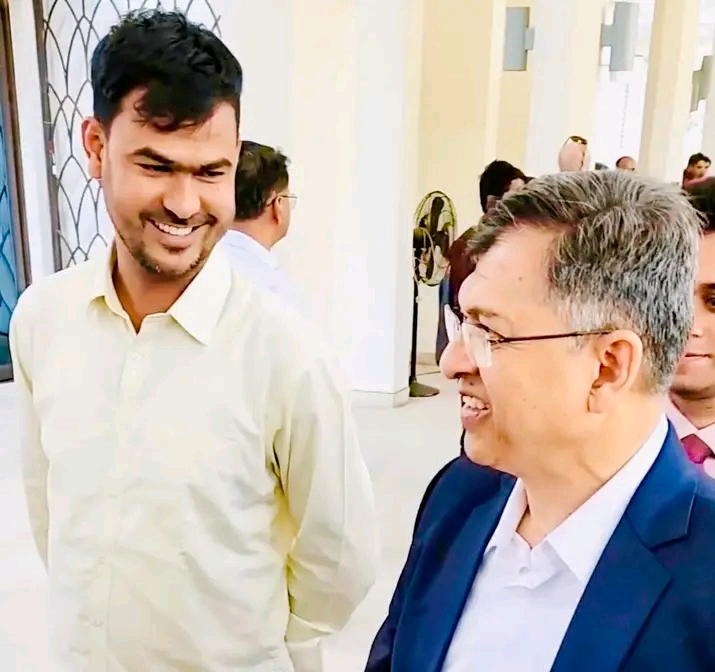
Salahuddin Ahmed, whom people call poet & professor of politics, has never been, was not, and will never be a conventional politician or policymaker. He possesses a remarkable ability to understand the perspectives of ordinary citizens, particularly those within bureaucratic institutions. Having survived enforced disappearance and exile, he remains steadfast in his refusal to capitulate to threats posed by resurgent fascists. He smartly communicates with the mass people. Despite the proliferation of calculated narratives and unverified critical commentary, public confidence in these accounts remains limited. However , it has developed a clear understanding of the distinction between rhetorical claims and factual reality.

Salahuddin Ahmed, the poet and professor of politics, has not had to be a traditional politician or policymaker. He can read the minds of the people, especially the bureaucrats, very well. He has survived disappearance and is not going to bow down due to the threats of fascists resurging; he speaks his mind to the people of his soil. Now, so much calculation & uncross-checked critical views have been demonstrated; however, the people hardly believe those narratives. People have learnt a big difference between rhetoric & reality.
Perhaps the most significant aspect of Salahuddin Ahmed’s administrative philosophy is not the ‘enforcement of law with a firm hand’, but rather the effort to transform the state’s law enforcement agency into an effective, accountable, and people-orientated institution.
Over the past 16 years, Bangladesh has witnessed the deaths, disappearances, and displacements of thousands of patriots who suffered under Sheikh Hasina’s oppressive regime.
He has witnessed the internal crises of law enforcement agencies firsthand.
He has seen the harshness of the state apparatus.
He has also seen the human crises within it.
Thus, the struggle to humanize law enforcement agencies and ensure their accountability is not merely an administrative duty for him.
It is also a part of his own political experience.
Who could understand this task more deeply than he does? He is, perhaps, one of the most consequential architects of this transformation.Under his leadership, this new architecture of law and order can be built in a more well-planned manner.
For this, he needs time.The institution needs time.The reforms need time.But today’s reality is different.
Social media algorithms demand quick decisions.
Public opinion forms even faster. Sometimes, it is based on emotion, exaggeration, or incomplete information.This algorithmic pressure can destabilize the state’s law and order system.
For law and order is not a project for instant popularity.
It is a task of building a long-term state institution.
Therefore, it is essential to allow time, stability, and political space for the potential institutional restructuring led by Salahuddin Ahmed.
Moving beyond today’s clamor, the ultimate test will be the sustainability of this architecture for a safe Bangladesh of the future.

Mahmud Didar is the editor of Daily Bangladesh first,