For long, BNP leaders have been urged to fix media issue. They have hardly paid attention to it. From 2001 to 2006, BNP was proved “worst” party by deliberate misreports, portrayal of Zia family as bad & what not. Newspapers play the most vital role in manufacturing consents on behalf of or against anything. Ershad Nabil Khan on his social media post demonstrated same concerns.
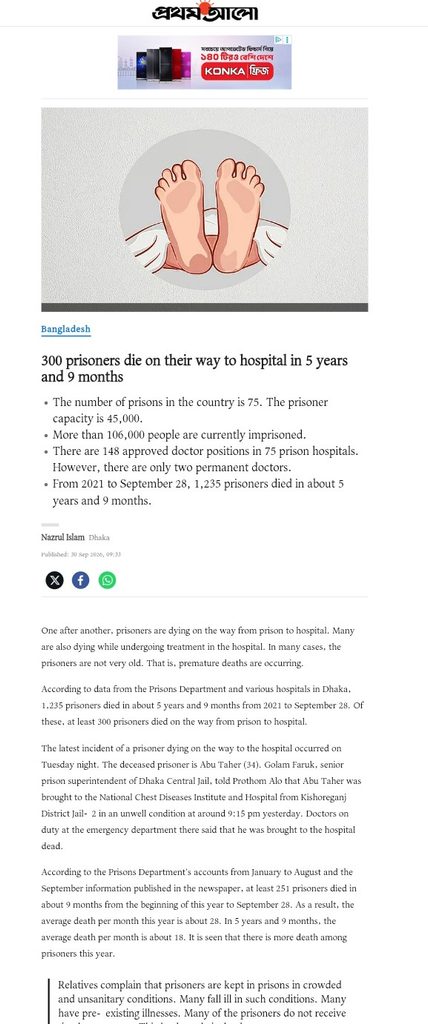
Look at the headline. What is your immediate impression? You might think that 300 prisoners died specifically during the BNP government’s tenure! However, the fine print below the headline—specifying a period of five years and nine months—might easily escape your notice. This is precisely what is known as “negative framing.”
It is not about denying facts, but rather presenting them in a way that instills a specific negative perception in the reader’s mind right from the start. That initial impression often solidifies into what people accept as the ultimate truth.
Such headlines are being selectively crafted in the name of freedom of speech. But the question remains: where is the Ministry of Information? Where is the Prime Minister’s Press Wing? Do they exist solely to disseminate photos of government programs, press releases, and formal statements?
The report also mentions that the prison population is more than double the facility’s capacity. What is the political implication of this?
“For the sake of Awami miscreants—please, don’t arrest them anymore!”
There is already a public perception—and discussion—that the police lack enthusiasm for apprehending leaders and activists of the banned ‘League.’ If, on top of that, a segment of the media consistently constructs a narrative that prioritizes the humanitarian plight of criminals or the accused, the situation becomes increasingly advantageous for the fascists.
The core issue here goes beyond a single news report; it is about who is shaping the narrative and who is countering it.
In politics, merely doing good work is not enough. You must also convey the data, context, outcomes, and rationale behind those good deeds to the public. If you fail to do so, someone else will write the story on your behalf.
If a single error or negative incident related to your government’s work is presented from ten different angles daily, while your ten genuine achievements fail to reach the public, you will inevitably fall behind in the battle to shape public opinion.
This is where the importance of media management, database management, and PR campaigns comes into play. Without an understanding of database manipulation, you cannot grasp how a single number can convey vastly different meanings depending on the context.
Without the ability to comprehend media narratives, you fail to realize how a headline can plant an initial impression in the minds of thousands.
And without appreciating the importance of PR campaigns, you cannot understand that merely possessing information is not the same as effectively communicating it to the public.
Particularly within the political realities of the developing world, a government cannot simply focus on administration; it must also skillfully manage the realms of information, narrative, and public opinion. Otherwise, while you do the actual work on the ground, someone else will write the story of that work.
You might drive development, yet the discourse will focus on your failures. You might solve a problem, yet that very problem will continue to dominate the news cycle. Ultimately, a large segment of the public will begin to accept a manufactured perception as reality rather than the actual facts.
Therefore, media management is not about silencing journalists. It is about presenting your government’s information, data, decisions, achievements, and stance to the public—at the right time, in the right context, and through effective communication.
Freedom of speech will exist—certainly. But shouldn’t the government also possess the freedom to disseminate information, the capacity to explain its position, and the organizational structure to counter false narratives?
In politics, there is no such thing as a vacuum. If you leave the narrative space open, someone else will step in to fill it.
Without media management, an understanding of database manipulation, and an appreciation for PR campaigns, your government in a developing nation is bound to become fragile.

Ershad Nabil Khan is a youth leader of Bangladesh nationalist party.