In an age of fluid social-media & free world, freedom of speech & expression have sometimes been conflated & merged with unverified, uncross checked false narrative which in Bangladesh perspective after 12 February election has turned into serious consequences resulting in Hitler’s PR Gueblosh style PR campaign by some YouTubers .
In the hyper-charged arena of Bangladesh’s post-transition politics, the digital ecosystem has increasingly transformed into a battleground of deceptive fabrications. At the storm’s center stands the Home Ministry, whose leadership now faces an unprecedented volume of coordinated disinformation campaigns designed to destabilize public order, manipulate sentiment, and undermine institutional credibility.
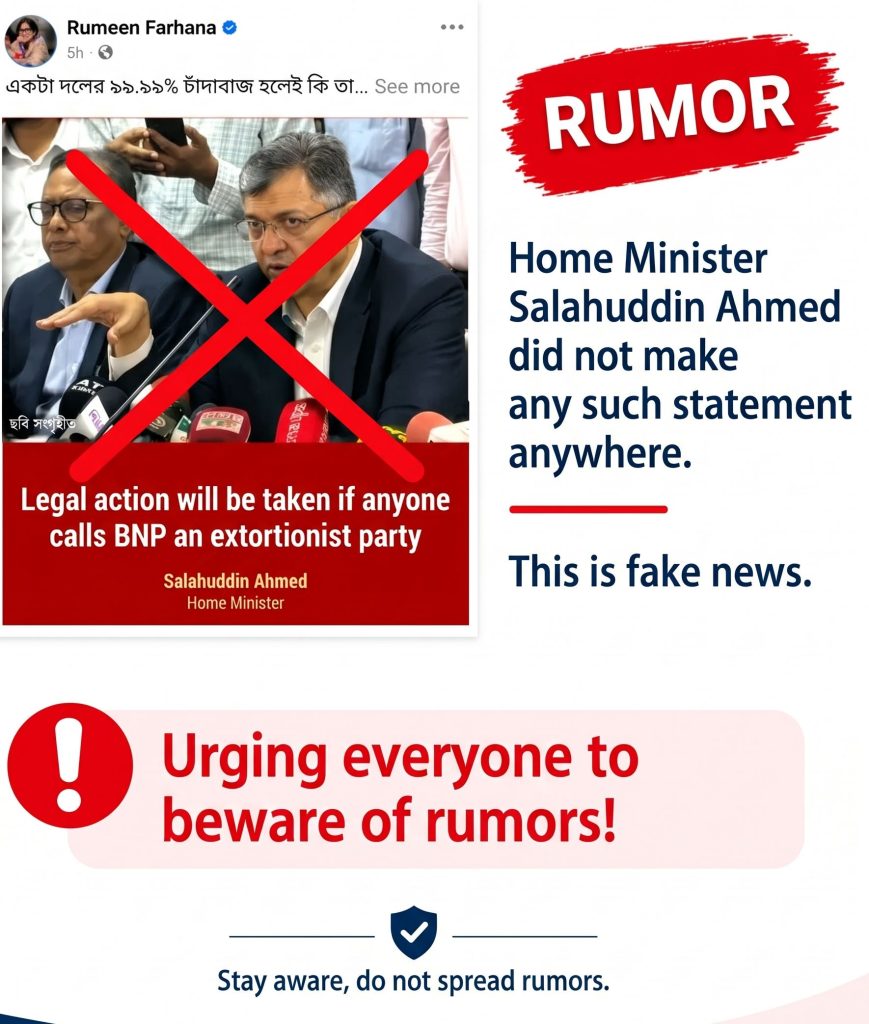
The latest disinformation surge centered on a synthetic photo card falsely quoting Home Minister Salahuddin Ahmed as declaring: “Legal action will be taken if anyone calls BNP an extortionist party”. Styled deceptively in the format of mainstream news banners, the card quickly ignited public debate. In reality, the Home Minister made no such declaration. Fact-checking desk investigations revealed that the card was doctored from satirical and disinformation-heavy pages, twisting his actual remarks—where he had stated that the public would evaluate politically motivated slander—into an authoritarian decree of state censorship.
The fabrication might have faded as fringe noise had it not received high-profile validation. The controversy escalated sharply when Barrister Rumeen Farhana, an independent lawmaker from Brahmanbaria-2, shared the unverified graphic across her official social media platforms with a provocative, critical caption.
The move triggered fierce backlash from political observers, media ethicists, and civil society. Critics pointed out that by laundering blatant digital falsehoods into mainstream discourse, Farhana’s actions effectively aligned with the subversive propaganda machinery of the fallen and fled fascist nexus striving to sow administrative chaos from exile.
Instead of exercising the basic scrutiny expected of a trained lawyer and parliamentarian, Farhana weaponized an outright fabrication to drive a partisan narrative. Critics argue that amplifying unsubstantiated rumors—especially those engineered to make state law enforcement appear partisan—crosses the line from legitimate democratic opposition into toxic disinformation.
The Anatomy of Engineered Chaos
The frequency with which the Home Minister is targeted reflects a deliberate strategy. By manufacturing quotes that suggest the police and ministry are suppressing public speech or protecting partisan figures, orchestrators of these campaigns seek to widen mistrust between citizens and state institutions.
When influential politicians lend their names and verified accounts to fabricated visuals, they grant synthetic propaganda instant legitimacy. As fact-checkers and ministry officials scramble to debunk each weekly fabrication, the damage is often already done in the court of algorithmic opinion.
Elected lawmakers bear a fundamental duty to uphold truth rather than pounce on unverified clickbait to settle political scores. For an independent parliamentarian to act as a megaphone for covert propaganda operations represents a failure of public trust. As the Home Ministry remains on the front line of cyber-disinformation, the incident stands as a stark warning: when public figures validate lies for momentary political mileage, the ultimate casualty is national stability.
During the last 9 months, Home minister has faced highest numbers of Rumors, mis & disinformation campaign which needs more awareness and rebuttals.