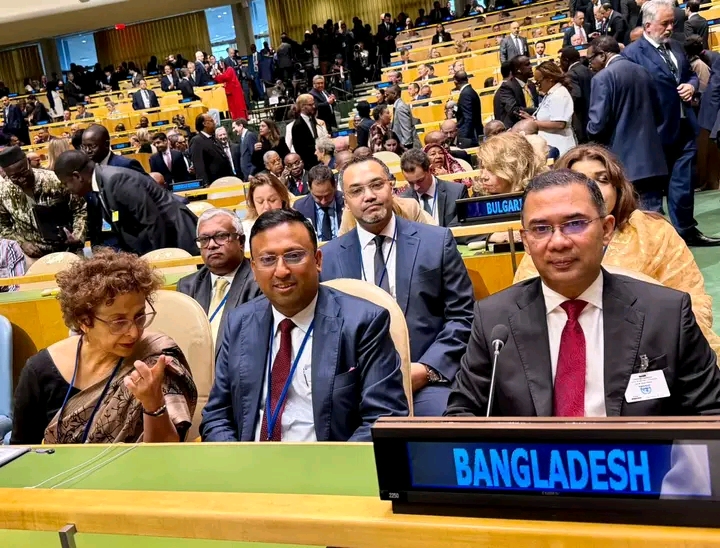
During the first UN Speech by the Prime minister Tarique Rahman, he has addressed Rohingya concerns as the top notch issue of concern for Bangladesh. Prime Minister Tarique Rahman has put forward a five-point proposal for a sustainable solution to the Rohingya crisis.
Simultaneously, he called for the formulation of a clear roadmap for the rapid, safe, voluntary, dignified, and sustainable repatriation of the Rohingyas; the cessation of violence; the assurance of adequate and predictable humanitarian assistance; the establishment of justice and accountability; and the strengthening of regional and international cooperation to combat trans-border crimes.
He presented these proposals while speaking as the chief guest at a high-level meeting on the Rohingya crisis, held alongside the UN General Assembly session on Tuesday at 11:00 AM local time.
Thanking the co-organizers and other partners of the event—jointly hosted by Bangladesh and The Gambia—the Prime Minister noted that for decades, the Rohingya people in Myanmar have been victims of extreme discrimination, persecution, and deprivation.
At the event, Prime Minister Tarique Rahman outlined five proposals to resolve the Rohingya crisis. These are:
First Proposal: International and regional stakeholders must formulate a clear and credible roadmap for the rapid, safe, voluntary, dignified, and sustainable repatriation of the Rohingyas. The international community must assist in efforts to bring stability to Myanmar and leverage its influence to create an environment conducive to repatriation.
Second Proposal: All forms of violence against the civilian population of Myanmar, including the Rohingyas, must cease immediately. Simultaneously, the fundamental rights and safety of the Rohingyas in their homeland must be ensured so that they regain confidence in returning safely.
Third Proposal: Alongside ensuring adequate and predictable humanitarian assistance for the Rohingyas, international support must also be maintained for the local host communities. The international community must ensure that the development aspirations of the local people in Cox’s Bazar are not hindered by their generous hospitality towards the Rohingyas.
Fourth Proposal: Establishing justice and accountability is essential for sustainable repatriation. In this context, the Prime Minister expressed gratitude for The Gambia’s leadership in efforts to ensure accountability at the International Court of Justice (ICJ). Highlighting the significant role of the International Criminal Court (ICC) and other international judicial and investigative mechanisms, she stated that those responsible for grave crimes must be held strictly accountable.
Fifth proposal: Regional and international cooperation must be further strengthened to combat the drug-fueled economy, human trafficking, digital fraud, illicit arms trade, and other cross-border crimes that incite instability in the region.
The Prime Minister noted that large numbers of Rohingyas have sought refuge in Bangladesh at various times since 1978. There were waves of Rohingya arrivals in the 1980s as well, and arrangements were made to repatriate some of them during the tenures of various past governments. However, the situation deteriorated drastically following the outbreak of fresh violence in Myanmar in 2017.
He also addressed that for over nine years, Bangladesh has been fulfilling its humanitarian obligations by sheltering a vast number of Rohingyas. Currently, more than 1.2 million Rohingyas are residing in Bangladesh. Moreover, people continue to flee Myanmar due to the ongoing violence there.
He further added that thousands of children are born in the camps every year, meaning a new generation is being added to the ranks of the long-term displaced. Rohingya mothers dream of a safe future for their children, the youth are growing up amidst extreme uncertainty, and the elderly harbor a deep longing to return to their homeland, cherishing memories of the homes and villages they left behind.
Noting that Bangladesh opened its borders and sheltered the Rohingyas out of humanitarian necessity, the Prime Minister said that food and healthcare services are being ensured in the camps. Rohingya children are receiving education based on the Myanmar curriculum through approximately 6,000 learning centers.
Simultaneously, the youth are being prepared for future reintegration into Myanmar’s Rakhine State through skills development training.
She stated that although Bangladesh is making every effort to improve living conditions in the camps, they are not ideal places for long-term habitation. Noting the mounting social, economic, environmental, and security pressures on Bangladesh due to protracted displacement, the Prime Minister stated that the burden of this crisis is not borne solely by the Rohingyas; the local host communities in Cox’s Bazar are also facing severe impacts. She pointed out that prolonged uncertainty and despair are giving rise to new challenges and security risks, including transnational crimes such as human trafficking, the smuggling of illegal migrants, and drug trafficking. Many are even risking their lives to travel to Malaysia by boat. An unresolved crisis of this nature in one country could evolve into a security challenge for the entire region.
Expressing concern over the shortfall in humanitarian assistance, the Prime Minister observed that while needs are escalating, the lifeline of humanitarian aid is shrinking. Although the Joint Response Plan (JRP) for 2025 sought over US$934 million in aid, the figure for 2026 has been reduced to approximately US$710 million—an amount sufficient only to meet minimum life-saving needs.
Stating that “this trend cannot continue,” he expressed deep gratitude to the international partners who have steadfastly stood by Bangladesh and emphasized that the need for international assistance is greater now than ever before.