How a survivor of Aynaghor views the 30 th August has been well-crafted in this piece.
Every year, on August 30, the world observes the International Day of the Victims of Enforced Disappearances.
For many people, it is another date on the international human-rights calendar. For survivors like me, it is something much more personal. It is a reminder of a time when I was taken away from the world, when my freedom was taken from me, when I could not tell my family where I was, and when the ordinary protections of law and society seemed to disappear along with me.
An enforced disappearance is not simply an arrest. It is not simply detention. It is the deliberate removal of a human being from the protection of the law, accompanied by the denial or concealment of that person’s fate or whereabouts. The United Nations recognises it as a serious violation of human rights. (United Nations ).
But legal definitions can never fully explain what it feels like to become the person everyone is searching for.
I know what it means to disappear :
I know what it means for the outside world to continue moving while your own world comes to a complete stop.
I know what fear feels like when you do not know what will happen to you next. I know what it means to be separated from your family and to understand that they have no idea where you are or whether you are safe.
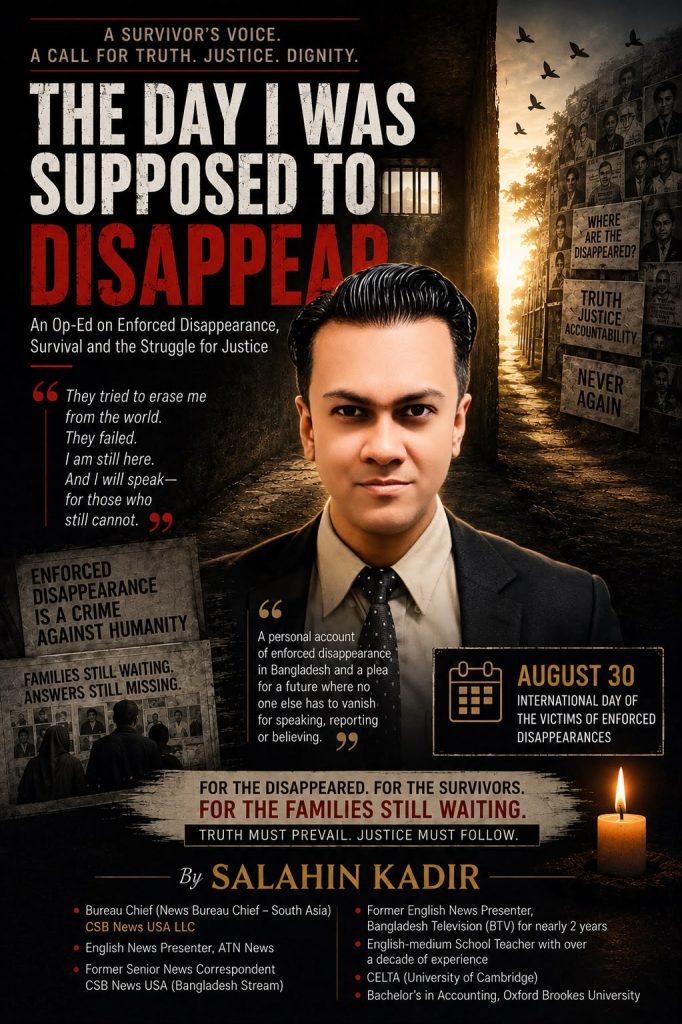
And I know that surviving does not necessarily mean that the disappearance ends. When a person is eventually released, the physical door may open, but the experience does not simply disappear with it. The memory remains.
The fear remains. The questions remain. There are experiences that change the way a person sees darkness, silence, footsteps, locked doors and even ordinary sounds. There are experiences that cannot easily be explained to someone who has never lived through them.
That is why I do not regard August 30 as merely an international observance. For me, it is a day of remembrance.
It is also a day of accountability.
A disappearance does not affect only one person
The word “victim” can sometimes make people think only of the person who was taken. That is too narrow. When one person disappears, an entire family enters a state of uncertainty. Parents wait. Children ask questions. Spouses live with fear. Siblings search for answers.
Friends wonder whether they should speak. And families are often left confronting the cruelest question of all: Where is he? The United Nations itself recognises that enforced disappearance inflicts profound anguish on families because they are denied knowledge of what happened to their loved ones. (United Nations ) .
That uncertainty can become a punishment in itself. Death, however devastating, gives a family an unbearable certainty.
Disappearance gives them neither certainty nor closure. Bangladesh cannot afford to forget Bangladesh’s experience with enforced disappearances has been documented for years by international human-rights organisations and other observers.
Human Rights Watch documented cases of secret detention and enforced disappearance and reported allegations of torture and other ill-treatment in secret custody. (Human Rights Watch ).
These are not merely numbers in reports. Behind every number is a name. Behind every name is a family. Behind every family is a story.
And behind every survivor is a life that has been permanently altered. My own experience has taught me that the greatest danger after such violations is not only forgetting what happened.
It is normalising it. A society becomes vulnerable when people begin to believe that disappearing someone can be justified because of his political views, profession, opinions, associations or alleged activities.
No government, institution or security agency should possess the power to make a human being disappear without accountability. The rule of law means precisely the opposite. If someone is accused of a crime, there must be a lawful arrest.
There must be due process. There must be access to a lawyer. There must be a court. There must be evidence. There must be accountability. There cannot be a system in which a person can simply vanish.
Survival is not the same as justice
One of the most difficult lessons I have learned is that surviving an enforced disappearance does not automatically mean receiving justice. A survivor may return home, but the questions remain. Who ordered it? Who carried it out?
Where was the person kept? What happened during detention?
Why was the person denied the protection of the law? Who will be held responsible? And perhaps most importantly: How do we make sure that it never happens again? These questions are not motivated by revenge. They are questions of justice.
The purpose of accountability is not merely to punish individuals. It is to establish a principle: that no institution is above the law and no human being is beneath its protection. The United Nations has repeatedly emphasised the need for truth, accountability, justice and reparation for victims and their families. (United Nations )
That is what survivors deserve.
Not pity. Not political slogans. Not silence. Truth. Justice. Dignity. And guarantees that it will not happen again. I refuse to let my disappearance become my identity.
There is another reason why I speak about this. I do not want the worst chapter of my life to become the definition of my entire life. I was disappeared.
But I am not a disappearance. I was a victim. But I am not merely a victim. I survived. And survival carries a responsibility: to remember, to speak when one can, and to stand with those who still cannot speak for themselves.
There are families who continue to wait. There are survivors who continue to carry memories they cannot easily describe.
There are people who are still afraid to speak. And there are stories that have not yet been told. Their stories deserve to be heard. August 30 is not only about the past For me, August 30 is not simply a day to remember what happened years ago. It is a warning about what must never happen again.
The real measure of a country’s commitment to human rights is not how it treats people who agree with those in power. It is how it treats those who disagree, those who are accused, those who are unpopular, and those who are vulnerable.
A state does not demonstrate its strength by making people disappear. It demonstrates its strength by ensuring that every person is protected by the law.
That is why I remember August 30. I remember not because I want to remain trapped in the past, but because I want to ensure that the past does not become someone’s future. I remember for those who never returned. I remember for the families still waiting for answers.
I remember for the survivors who carry invisible wounds. And I remember for myself. Because there was a time when someone tried to make me disappear.
They failed. I am still here. And as long as I am here, I will continue to believe that truth matters, that justice matters, that human dignity matters and that no person should ever be made to disappear.
August 30 should therefore not be merely a day of remembrance. It should be a day of reckoning. A day to ask where the disappeared are, what happened to them, who was responsible, and what we are doing to ensure that no one else disappears tomorrow.
About the Author
Salahin Kadir is a Bangladeshi broadcast journalist, news presenter and educator with extensive experience in journalism and English-medium education. He currently serves as Bureau Chief (News Bureau Chief – South Asia) for CSB News USA LLC and is also an English News Presenter at ATN News, where he presents the English news bulletin. Previously, he served as a Senior News Correspondent with CSB News USA (Bangladesh Stream) and presented English news on Bangladesh Television (BTV) for nearly two years, including during the pre- and post-COVID period. Alongside his journalism career, Salahin Kadir has more than a decade of experience as an English-medium school teacher and has been involved in the English Medium Teachers’ Committee.
He holds a CELTA qualification from the University of Cambridge and a Bachelor’s degree in Accounting from Oxford Brookes University. His professional interests include journalism, broadcasting, education, English-language communication and international affairs.
His professional interests include journalism, broadcasting, education, English-language communication and international affairs. As a survivor of enforced disappearance, Salahin Kadir also speaks and writes from personal experience about human rights, justice, accountability and the lasting impact of enforced disappearance on survivors and their families.
This Op-Ed reflects his personal experience and perspective as a survivor and is written in solidarity with victims and families of enforced disappearance in Bangladesh and around the world.